TOP 5 HEALTH LAWS AND POLICY UPDATES

Dear Readers, we are happy to share the most interesting legal and policy updates concerning health industry that we read today. We hope you enjoy reading it.

1. The Ministry of Health has issued draft amendments to the New Drugs and Clinical Trials Rules, 2019, proposing to remove the provision dealing with the provisional registration of Ethics Committees. The designated authority will now directly grant final registration in Form CT-03 after scrutiny of Form CT-01, or reject with written reasons.
Source: h7.cl/1oifC

2. Bulk Drug Manufacturers Association of India has launched a marketing portal enabling Indian pharmaceutical companies to promote and source active pharmaceutical ingredients, intermediates, pallets, and contract development and manufacturing services, supporting both domestic and international markets through an integrated vendor management system with no cost registration for buyers.
Source: h7.cl/1oifJ

3. The Department of Pharmaceuticals has extended the deadline for submitting applications under the Common Facilities for Medical Device Clusters (CFMDC) sub-scheme to 15 February 2026. The scheme supports shared testing infrastructure for medical devices, including cardiac and orthopaedic implants, infusion pumps, imaging equipment, and Class B, C, and D IVDs.
Source: h7.cl/1jfLz

4. The Maharashtra government has issued a resolution by introducing a new fee structure at state-run hospitals from effective from January 16, 2026. ₹5 for OPD registration, ₹10/day for inpatient admission, and up to ₹40,000 for major surgeries like joint replacements. Diagnostic services, ICU care, and ambulance services also have updated charges. Implementation across hospitals is pending.
Source: h7.cl/1oiwW

5. The Indian Pharmacopoeia Commission is reportedly taking efforts to develop more biosimilar in alignment with governments Biopharma Shakti initiative. This move aims to align Indian quality standards with global benchmarks and strengthen the country’s biologics and biosimilars ecosystem.
Source: h7.cl/1jfLU

TOP 5 HEALTH LAWS AND POLICY UPDATES

Dear Readers, we are happy to share the most interesting legal and policy updates concerning health industry that we read today. We hope you enjoy reading it.

1. India’s Ministry of Health has issued draft amendments to the New Drugs & Clinical Trials Rules, 2019 introducing a framework for filing of post-approval changes in new drugs. Manufacturers of new drugs may have to take prior approval from the authorities for major and moderate quality changes while minor quality changes might be implemented without prior approval and changes which might have a minimal effect can be implemented with annual submission by 1st quarter of every calendar year to the authorities.
Source: h7.cl/1odSN

2. The Delhi High Court upheld the conviction of a sweet manufacturing unit for discharging untreated effluents into public sewers leading to the Yamuna River. However, citing the 2024 amendment to the Water Act, which replaces imprisonment with monetary penalties, the court set aside the jail term and imposed an ten lakh rupees penalty, underscoring strict environmental compliance.
Source: h7.cl/1jbwq

3. The National Biodiversity Authority has launched a digital portal for electronic issuance of Certificates of Origin for cultivated medicinal plants, enabling access and benefit sharing exemptions. The initiative operationalises the amended Biological Diversity framework, offering a single window online process for traditional medicine, seed and research sectors.
Source: h7.cl/1odSP

4. The Government has amended the Plant Quarantine Order to permit the import of dried Mitragyna speciosa (Kratom) leaves from Uganda for processing, subject to a phytosanitary certificate confirming the consignment is free from soil, quarantine weed seeds, and other plant debris.
Source: h7.cl/1jbwX

5. The Karnataka High Court has stayed a penalty imposed by the Central Consumer Protection Authority on an e-commerce platform for allowing the sale of walkie-talkies without mandatory licensing disclosures. The E-commerce platform had argued that its liability is limited owing to it being a mere intermediary.
Source: h7.cl/1jbx0

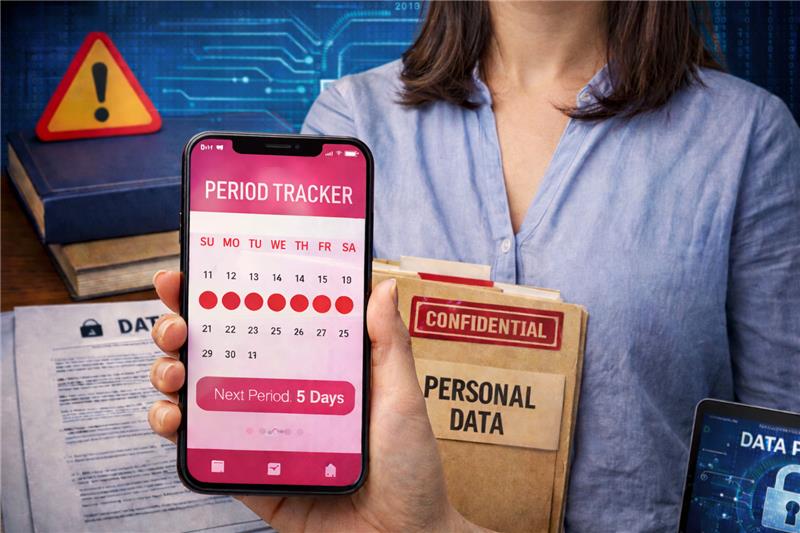
Blood, Bodies and Personal Data: How Period Tracking Apps approach privacy rights of menstruating individuals, from the lens of Digital Personal Data Protection Act, 2023 and Digital Personal Data Protection Rules, 2025

Digital health technologies are repositories of some of our most intimate personal data. Most menstruating individuals who use menstrual and fertility tracking apps (referred to as “period tracking apps” hereafter) regularly record the most private aspects of their life, such as cycle dates, symptoms, mood, sexual activity, and fertility patterns (referred to as “menstrual data”) on these apps while looking for predictability and awareness of their own body and its functioning. Implicit in this use is an assumption that the app will protect their sensitive personal information and that it will not be disclosed or shared with anyone, especially without their informed consent.

However, investigations and regulatory findings in various countries have revealed that period tracking apps collect sensitive personal data beyond what is necessary for service delivery, retain such data for extended periods of time and share it with third-party advertisers or analytics platforms without the knowledge of unsuspecting users.

Law to protect privacy in India
A privacy-focused law called the Digital Personal Data Protection Act, 2023 (“DPDP Act” or “Act”) was passed in 2023. The Act introduces a definitive legal framework for the protection of digital personal data, but it has been largely ineffective thus far, owing to the absence of rules which can translate the legal framework into concrete obligations with accountability.

The Indian Government has notified the Digital Personal Data Protection (DPDP) Rules, 2025 (“DPDP Rules”) under the DPDP Act on November 14, 2025. Before the enactment of the DPDP Act, the collection, storage, processing, disclosure and transfer of health-related personal information and data was regulated in a limited manner under the Information Technology (Reasonable Security Practices and Procedures and Sensitive Personal Data or Information) Rules, 2011 (“SPDI Rules”). However, with the introduction of the DPDP Act and DPDP Rules, the SPDI Rules are set to be replaced by May 13, 2027. The DPDP Rules are expected to give teeth to the DPDP Act since they enumerate real obligations on entities that process personal data.

This article will critically examine whether the protections put in place by the DPDP Act and DPDP Rules are sufficient to protect the personal data of menstruating individuals which is being collected and stored in period tracking apps.

Data processed by period tracking apps
Menstrual data is not just informational. Unlike most health data, which is often a record of isolated medical facts, menstrual data is inherently derivative and inferential in nature. From seemingly simple menstrual cycle logs, it is possible to predict pregnancy, miscarriage, or abortion; indicate underlying conditions such as Polycystic Ovary Syndrome (PCOS) or endometriosis; and enable profiling relating to marital status, sexual behaviour, fertility preferences, and broader reproductive choices. The misuse of such data can result in stigma, discrimination, coercion, or even physical risk. Therefore, menstrual data is not merely sensitive; it is sacrosanct and private.

Consent, purpose and necessity framework for processing personal data
Under the DPDP Act, owners and operators of period tracking apps are known as “data fiduciaries”. The DPDP Act has imposed an obligation on data fiduciaries to obtain valid consent from users who come under the definition of “data principals” before any collection, storing and processing of data principals’ personal data. The consent given by a data principal has to be free, specific, informed, unconditional and unambiguous, with a clear affirmative action. Further, any processing of such personal data must be limited, i.e., as is necessary for performing the specified purpose that was informed before or at the time of taking consent.

For period tracking apps, a bundled consent mechanism and ambiguous privacy policies will now turn out to be unlawful. Such apps must explicitly disclose (i) what menstrual data is collected with a description; (ii) the specified purpose of such collection (including whether it is shared, with whom, and for what purpose); (iii) a mechanism for withdrawal of consent, exercise of rights, including making complaints to the Data Protection Board.

As stated above, before requesting specific consent, the data fiduciary is required to describe the specified purpose for processing personal data. However, there is currently no guidance on the standards a data fiduciary should follow while describing a specified purpose, which begs the following question: Should the specified purpose be left to be determined by data fiduciaries who are running businesses and would be inclined to expand the specified purpose as much as possible? If the data fiduciaries who runs period tracking apps decides to include “use of menstrual data for recommendation of health services and health service providers” as another specified purpose in addition to access to period tracking service, and start sharing the personal data of menstruating individuals users to doctors and hospitals in form of leads, it won’t be unlawful, if the unsuspecting user has granted their consent to such “specified use”.

Therefore, in the context of period tracking applications, the ability of a data fiduciary to define a specified purpose in broad or unrelated terms and seek specific consent from unsuspecting users creates a systemic vulnerability for menstruating individuals who use period tracking app. A period tracking app may lawfully define its specified purpose to include targeted advertising, behavioural analytics, or commercial use of such data, provided such purposes are disclosed and consented to. The Act does not impose an independent test of necessity, proportionality, or contextual legitimacy of the specified purpose, nor does it prohibit certain uses of menstrual data outright. In this way, the current privacy framework under the DPDP Act and DPDP Rules risks reducing consent to a mere formality, insufficient to protect menstruating individuals from exploitative or intrusive uses of their most intimate menstrual data.

Derivative and Anonymised Data: Limits of the Right to Erasur
Pursuant to the DPDP Act, the users have an explicit right to access their stored (menstrual) data, correct inaccuracies, seek erasure where the specified purpose they consented to is served or when they withdraw consent. Hence, among the rights conferred on data principals under the DPDP Act, the right to erasure is particularly significant in the context of period tracking apps. Historically, such apps have relied on indefinite and discretionary retention of menstrual data and have thrived on years of cycle history that make their predictions more “accurate” by training their models, as well as to benefit from the economic value of such data by selling it to third parties. The DPDP Act makes it unlawful to do so now.

However, a challenge remains in the context of derivative and AI-generated data because the DPDP Act does not distinguish between original personal data and inferences drawn from it, i.e., derivative personal data. In other words, derivative menstrual data remains “personal data” so long as it relates to an identifiable individual. Therefore, when it comes to erasure of such personal derivative menstrual data, the right of erasure turns out to be ineffective as once an individual’s menstrual data has been incorporated into a trained (AI) model, the underlying data cannot be extracted, separated and deleted in any meaningful sense. Even after a user requests deletion of their personal data, the model may continue to draw on patterns derived from that data to infer or predict similar outcomes.

Another risk is that of anonymisation, which is often presented as a solution to privacy concerns. Yet menstrual data, even when stripped of personal information, can be re-identified when combined with other datasets. It can also enable group-level profiling (e.g., fertility trends in a region, age group, or socio-economic class). Further, the DPDP Act does not specify standards for what level of anonymisation is sufficient, or who bears the burden of proving irreversibility.

This gap becomes particularly consequential when such menstrual (derivative or anonymised) data is retained indefinitely, perhaps even monetised, or used to train predictive or AI-driven systems.

Minors, Consent, and Menstrual Privacy
It is worth noting that a substantial number of period tracking app users include teenagers. The DPDP Act introduces strict “verifiable parental consent” for those under the age of 18. Verifiable consent entails that the individual who has provided parental consent – his/her identity is checked, age is confirmed, using reliable or government-backed identity verification methods. While intended as a protective measure, this requirement may unintentionally undermine the privacy of minors.

In many social contexts, young users may not feel safe or comfortable discussing menstrual health or sexual activity with their parents. Mandatory parental consent could therefore discourage minors from using digital tools that help them manage their reproductive health, effectively denying them confidential access to essential health information.

Conclusion
It is undeniable that the DPDP Act and DPDP Rules provide a legal framework for protecting the privacy of users of period tracking apps in India. However, when applied to menstrual data, certain limitations become evident where clearer guidance and interpretation are needed.

The current framework does not fully account for the unique sensitivity of menstrual information, the realities of AI-driven processing, the risks of derivative and anonymised data, and the potential inadvertent exclusion of minors from period tracking apps. Without clearer restrictions on permissible uses and stronger safeguards, the law risks treating deeply intimate bodily data as ordinary consumer information.

To fill the gap, one potential solutions could be that the schema of the DPDP Act itself be tweaked to treat menstrual and other sensitive health data as a special category or sensitive form of data requiring higher standards of protection, much like the outgoing SPDI Rules which categorically labelled health data as sensitive data and EU General Data Protection Regulation (GDPR) that treats menstrual data as “Special Category Data”.

Adopting a comparable approach under the DPDP Act and DPDP Rules would ensure that menstrual data receives the heightened protection it deserves. Without such reforms, the privacy of millions of menstruating individuals using period tracking apps will remain unsecured and exposed to potential misuse.


TOP 5 HEALTH LAWS AND POLICY UPDATES

Dear Readers, we are happy to share the most interesting legal and policy updates concerning health industry that we read today. We hope you enjoy reading it.

1. The Ministry of Health and Family Welfare has constituted a committee to develop a policy governing refurbished medical devices. The committee will examine the scope of refurbished medical devices, methodology to evaluate the safety, performance, and remaining useful life of refurbished medical devices & suggest guidance for waste disposal of such refurbished devices.
Source: h7.cl/1o8qd

2. Indian government has announced a tax holiday until 2047 for foreign companies that provide cloud services globally using data centres located in India. Further, there will be no risk of foreign firms’ global income being taxed in India solely because they use Indian data centres. This move is aimed at attracting long-term investment into India’s digital infrastructure.
Source: h7.cl/1o8qp

3. Indian Government has released first national evidence-based lung cancer treatment and palliation guidelines. It offers 15 recommendations to standardise diagnosis, treatment and palliative care, improve early detection, reduce treatment disparities and ensure consistent, patient-centred care across the country.
Source: h7.cl/1o8qA

4. India’s Ministry of Consumer Affairs issued show-cause notices to major edible oil companies for violating the amended Vegetable Oils Products, Production and Availability (VOPPA) Order, 2025. Companies failed to submit monthly production data and register on official portals. Authorities have warned that continued non-compliance could lead to inspections and confiscation under the Essential Commodities Act, 1955.
Source: h7.cl/1o8qN

5. The United States Food and Drug Administration has launched the PreCheck pilot program to strengthen domestic pharmaceutical manufacturing. The initiative offers early regulatory engagement for new manufacturing facilities, improving predictability, streamlining facility assessments and accelerating readiness to supply medicines for the United States market.
Source: h7.cl/1o8qS

TOP 5 HEALTH LAWS AND POLICY UPDATES

Dear Readers, we are happy to share the most interesting legal and policy updates concerning health industry that we read today. We hope you enjoy reading it.

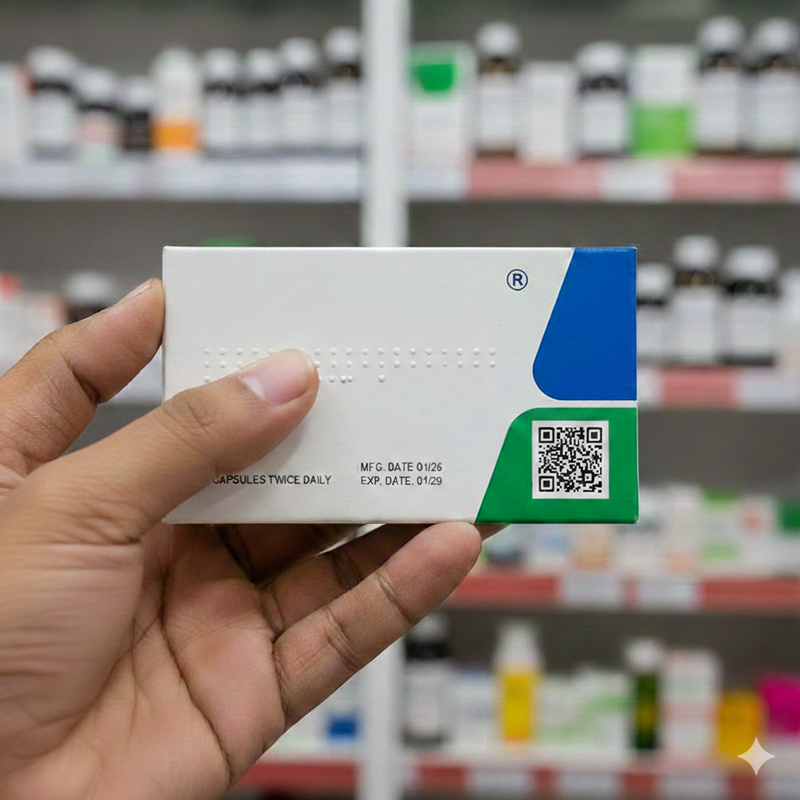
1. The Karnataka Health Department has proposed introducing QR codes on medicine strips and boxes to help visually impaired patients access key drug information via smartphone scanning under the IMPACT-VIP programme. Details such as dosage, composition, and expiry dates can be accessed, and the proposal may be sent to the Centre for wider implementation.
Source: h7.cl/1o2Wy

2. India’s central drugs regulatory authority (CDSCO) has released a draft guidance outlining regulatory requirements and online procedures for importing in-vitro diagnostic medical devices. The document aims to streamline approvals under Medical Devices Rules, 2017. Comments from stakeholders are invited within 15 days.
Source: h7.cl/1j0Wg

3. The Government of India has in the Union Budget 2026–27 announced measures to position India as a hub for medical tourism, biopharmaceutical manufacturing and traditional medicine. The government will establish five regional medical hubs, expand Ayurveda, Yoga, Unani, Siddha and Homeopathy infrastructure, and strengthen research, manufacturing capacity and employment across the healthcare value chain.
Source: h7.cl/1o2WE

4. The Government of India is planning to amend the Drugs and Cosmetics Act to tighten oversight of pharmaceutical opioids, proposing stricter penalties, higher fines, and enhanced monitoring of manufacturing and sales to curb misuse, diversion, and illegal distribution while strengthening regulatory enforcement.
Source: h7.cl/1j0Wr

5. Indian Pharmacopoeia Commission has issued a formal circular urging all Medical Device Marketing Authorisation Holders (MAHs) to strictly comply with adverse event reporting requirements under the Materiovigilance Programme of India (MvPI). The move is aimed at bolstering patient safety and enhancing the post-market surveillance ecosystem for medical devices across India.
Source: h7.cl/1o2WQ

Braille labelling on medicines in India for Visually Impaired Persons: Recent Developments

Ensuring that all citizens can safely access and use medicines is a fundamental marker of an inclusive and progressive society. Many countries recognize that equitable healthcare requires not only affordable medicines but also accessible information about them. While several jurisdictions have made notable progress in mandating Braille labelling and accessible formats on medicines, India is steadily advancing along a similar path.

Legal and policy context in India:
The Indian law which governs labelling of medicines is the Drugs and Cosmetics Act, 1940. It focuses on the safety and authenticity of medicines but is silent on the specific accessibility needs of persons with disabilities. The Indian law which protects rights of disabled persons, The Rights of Persons with Disabilities (RPWD) Act, 2016, mandates equality, non-discrimination, and accessible information in audio, print, and electronic formats. However, these rights have not yet been translated into compulsory standards for accessible drug labelling.

Global practices and Indian judicial activism
In the European Union, medicine name labelling in Braille on outer cartons is legally required for most patients handled prescription medicines under Directive 2001/83/EC (as amended), enabling many visually impaired people to manage medicines more independently.

India has shown forward movement through judicial activism. Notably, the Supreme Court of India, in response to a public interest petition (W.P.(Civil) No. 516 of 2024), issued a notice via its order dated 27 August 2024, seeking responses from government on guidelines for implementing a Braille Integration System on medicine prescriptions, strips, labels, consumer products, and currency notes. The petition detailed the serious barriers faced by visually impaired people: difficulty in identifying currency notes, reading product labels, and managing prescriptions independently. These issues, the plea argued, constitute violations of the constitutional rights to equality and dignity under Articles 14, 16, 19, and 21 of the Indian Constitution. It also emphasized how the absence of Braille on key everyday items forces visually impaired citizens to depend on others for essential information in public and private settings.

Separately, Indian courts have directed platforms like Netflix and other OTT services to make their user interfaces more accessible, including audio descriptions for the visually impaired. These examples show courts stepping in to advance accessibility where government policy has lagged.

Current regulatory efforts and their limitations:
India’s central drug regulatory authority, the Central Drugs Standards Control Organization (CDSCO), has recently acknowledged these longstanding issues and on 9th September 2025, it invited stakeholder comments on proposals to address the challenges faced by blind and visually impaired individuals when reading tablet and capsule strips. Key recommendations included:

  • Introducing Braille labelling on medicines supplied in mono-carton packs on a voluntary basis initially, prioritizing products like eye drops that are frequently used by visually impaired patients.
  • Including Braille cards with secondary packaging for medicines supplied in bulk quantities exceeding ten units.
  • Adding QR codes on packaging linked to voice assistance technology to provide audio-based medicine information.
  • Ensuring that Braille labels are validated by recognized institutions such as the National Institute for the Empowerment of Persons with Intellectual Disabilities (NIEPID), in conjunction with the Braille Council of India.
  • Exempting medicines administered solely by healthcare professionals (injectables, vaccines), although concerns remain around the exclusion of certain self-administered devices like prefilled injection pens.
  • Making available patient information leaflets in accessible formats such as Braille, large print, and audio versions upon request.
  • Advising pharmacists and retailers to provide verbal guidance to visually impaired patients concerning medicine names, dosages, expiry dates, and usage instructions.

However, these initiatives have so far only been offered for stakeholder comment and feedback, with no clear timetable for adoption or any mandatory framework for implementation. As a result, there remains significant uncertainty about when these measures will become legally binding and uniformly enforced across the pharmaceutical industry. This leaves millions in continued limbo, dependent on voluntary compliance rather than assured rights, and underscores the urgent need for the government to move from consultation to concrete action.

The human impact and need for urgency:
For visually impaired individuals, inaccessible drug labelling creates daily challenges and safety risks. The inability to read medicine names, expiry dates, and dosage instructions often leads to dependence on caregivers and undermines autonomy and dignity. Prolonged consultations and voluntary measures have repeatedly failed to address these realities.

What is expected versus what is realistically doable
There is a clear gap between regulatory ambition and on-ground feasibility. Expecting full Braille labelling on every primary strip or blister pack presents technical, spatial, and cost challenges, particularly for medicines with small packaging or high-volume generic production. At the same time, doing nothing perpetuates risk and dependence.

The critical question, therefore, is not whether accessibility should be provided, but how it can be implemented in a manner that is practical, scalable, and enforceable across India’s diverse pharmaceutical and retail ecosystem.

Practical alternatives and pharmacist-led solutions
A more workable approach may lie in standardized yet flexible solutions. Instead of attempting to place complete Braille information on every label, manufacturers could be required to maintain one standardized Braille specimen for each product, covering information required on drugs label as per the Drugs Rules, 1945. This specimen could apply to both the label content and the patient information leaflet.

Retail pharmacists could then play a central role by keeping these Braille specimens or accessible leaflets available at the point of sale and providing them on request, alongside verbal counselling. QR codes linked to verified audio instructions could further complement this system, allowing patients to access information privately and independently.

Such an approach recognizes operational realities while still advancing accessibility in a meaningful way that pharmacists and retailers can realistically manage.

Conclusion:
Millions of visually impaired Indians continue to face significant barriers because medicine labels remain inaccessible. This is not merely an inconvenience, it directly affects safety, independence, and dignity. When people cannot read labels, they are forced to rely on others to manage their health.

With binding regulations, clear timelines, and thorough enforcement, the Indian Government has the ability give every individual the confidence and freedom to manage his or her health safely and independently.

TOP 5 HEALTH LAWS AND POLICY UPDATES

Dear Readers, we are happy to share the most interesting legal and policy updates concerning health industry that we read today. We hope you enjoy reading it.

1. The Government of India has in the Union Budget 2026–27, removed basic customs duty on 17 cancer drugs to reduce treatment costs. The move aims to ease the financial burden on patients, particularly for high-cost imported therapies, and improve access to essential cancer medicines across the country.
Source: h7.cl/1nZbu
#Drugs #Cancer #CustomDuty #Slashed #Budget2026

2. The Supreme Court of India has held that administering stem cell therapy for Autism Spectrum Disorder (ASD) outside an approved clinical trial setting is unethical and amounts to medical malpractice. The Court clarified that such therapy is not recognised as a sound and established medical practice due to the lack of scientific validation of safety and efficacy. The same is permissible only for an approved and monitored clinical trial with the intent to advance science.
Source: h7.cl/1nZbb

3. Maharashtra’s State Blood Transfusion Council has reportedly warned blood banks against collecting excess blood and transferring it to other states for profit. Violations, including commercial supply to plasma fractionation companies, may invite licence cancellation, as centres are directed to collect only patient-linked requirements to protect voluntary donation ethics.
Source: h7.cl/1iYh-

4. The Enforcement Directorate reportedly conducted searches at twenty six locations across multiple states as part of a probe into illegal international narcotics trafficking and money laundering. Investigations revealed a structured interstate drug network, leading to seizure of cash, narcotic substances, contraband, and incriminating documents indicating organised distribution and laundering activities.
Source: h7.cl/1nZbD

5. The Government of India has proposed amending the Drugs Rules, 1945 to designate Navi Mumbai International Airport (NMIA) as an authorised drug import entry point, making it a 12th approved airport, improving logistics and reducing congestion at existing ports. Stakeholders have been requested to submit comments withing 30 days.
Source: h7.cl/1nZbN

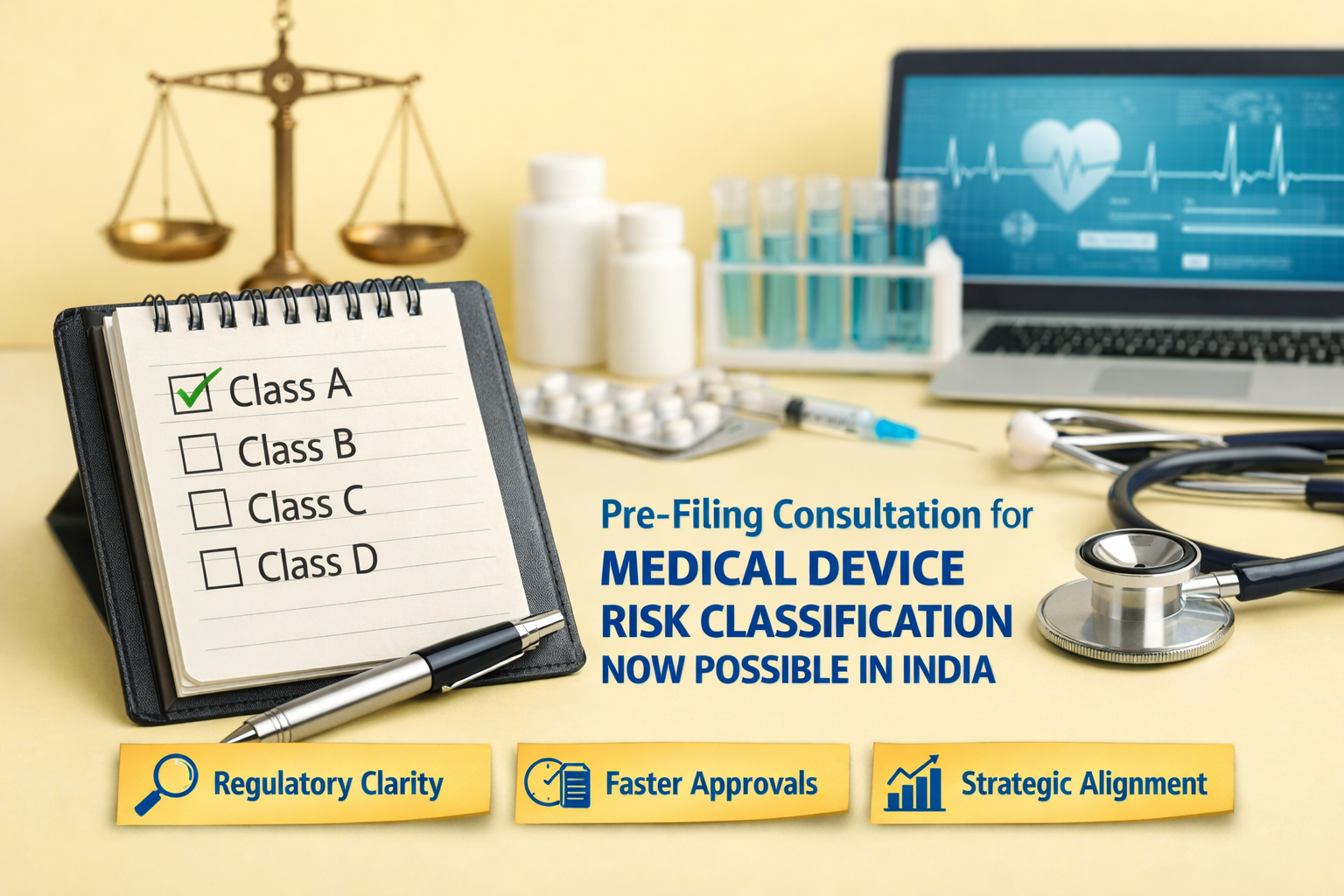
Pre-filing consultation for medical device risk classification now possible in India

India’s central medical device regulator, The Central Drugs Standard Control Organization (“CDSCO”), has introduced a facility that allows importers and manufacturers of medical devices who are desirous of ascertaining the risk classification of their medical devices to receive an official confirmation on risk classification from the CDSCO.

Regulatory context
India’s medical device regulatory framework differs from most other jurisdictions. In India, risk classification of medical devices is determined by CDSCO and is not self-declared by manufacturers and importers who are making the product license application.
Additional complexity arises from the fact that manufacturing licenses for Class A and Class B devices are issued by State authorities. This has resulted in inconsistent application of risk classification thresholds, with similar products receiving different risk classifications across states. Although CDSCO has issued directions to address this issue, practical challenges continue.

Why does risk classification matter?
The risk classification determines documents and data required, government fees and timelines for obtaining the product license. Therefore, risk classification is a key commercial and strategic factor.

Pre-filing consultation facility
To align risk classification and bring regulatory certainty, CDSCO has introduced a voluntary pre-filing consultation facility to confirm medical device risk classification. The facility is only available to manufacturers and importers of medical devices other than in-vitro diagnostic medical devices (IVDs).

Consultation fee
Please note that there is no consultation fee for availing the facility to determine risk classification of medical devices.

Documents required
In order to avail the facility, the manufacturer or importer is required to submit existing device labels, instructions for use, and the regulatory status of the device in other jurisdictions (like USA, UK, EU, Australia, Canada, or Japan), etc.

Timeline for receiving response on risk classification of medical device from CDSCO
There is no prescribed timeline, and the consultation is best undertaken in parallel with preparation of the main regulatory dossier of medical devices.

Key take-aways for industry
It is pragmatic to undertake pre-consultation when the risk classification of the medical device is unclear.
Early confirmation of risk classification allows companies to plan approval pathways with greater certainty, align licensing strategy at an early stage, and reduce regulatory friction. It also supports better coordination between India-specific regulatory requirements and global product positioning.

Disclaimer: This article is intended for general information purposes only and does not constitute legal advice

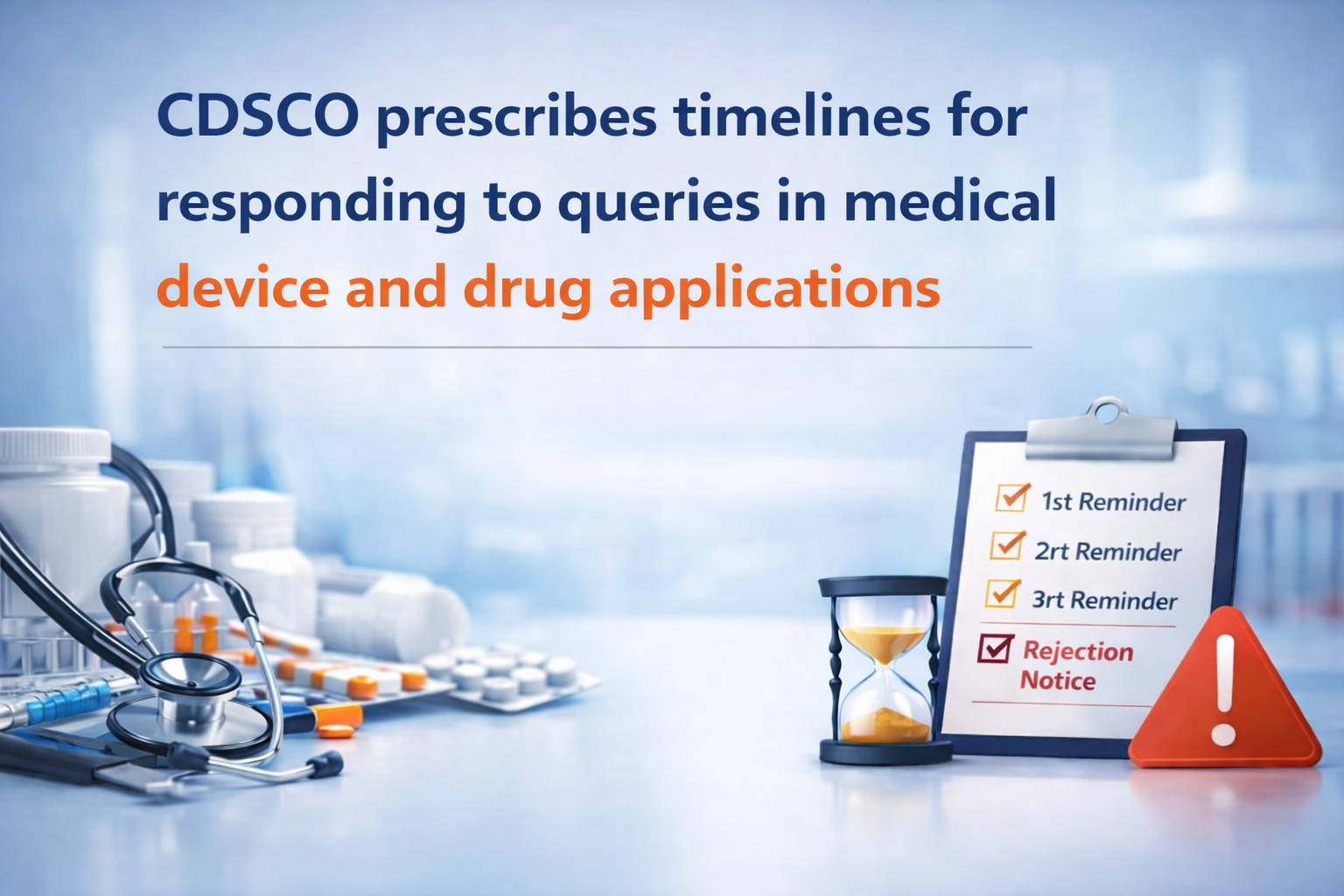
The 90 Day Rule: Indian Drug and Medical Device Regulator (CDSCO) tightens query response timelines on applications 

India’s Central Drug and Medical Device Regulator, The Central Drugs Standard Control Organisation (CDSCO), has made it clear that it will reject product applications if the official queries to the applications are not responded within 90 days from the date of receipt of the first official reminder.

Background
On January 16, 2026, CDSCO issued a public notice informing the general public that it has initiated a time-bound reminder and rejection mechanism to ensure timely disposal of the pending applications. As per CDSCO, a large number of product applications across categories such as new drugs, cosmetics, biologics, medical devices and IVDs are pending since 8 to 10 years because of non- submission of responses to queries on product application raised on the official electronic submission portal (SUGAM portal).

In the notice, CDSCO issued a final warning to applicants whose application has been pending for more than two years for want of response to queries and who have received three reminders from CDSCO requesting submission of response to query. If such applicants fail to respond to queries within 30 days from date of public notice i.e. by 14 February 2026, it will result in rejection of the application.

The CDSCO also used the opportunity to inform the public that it has instituted a structured reminder mechanism for queries to applications under which it was going to issue three reminders to applicants in relation to unresponded queries. This structured reminder system and consequences of failing to respond to queries are discussed in the paragraphs below.

CDSCO’s Structured reminder mechanism
Under the structured reminder mechanism, CDSCO has decided that it will issue reminders at fixed intervals to applicants who do not respond to the official queries to an application in the following manner:

  • First Reminder- CDSCO will issue the first reminder if it does not receive response to query. The time-period that CDSCO will wait for response to queries before it issues the first reminder has not been specified.
  • Second reminder – If no response to queries is received within 30 days of first reminder, a second reminder will be issued o.
  • Third reminder – If no response to queries is received within 30 days of second reminder, a third and final reminder will be issued.
  • Disposal Notice – If no response to queries is received within 30 days of issuance of third reminder, CDSCO will issue dispose the application.

Will the disposal of application due to non-response to queries be treated as rejection of the application effectively barring the applicant to make the same application again?
The disposal by CDSCO should not be treated as rejection of the application. This means that the applicant should be able to apply for license again for the same products, even if the application for same products has been rejected before for want of response to queries.

Whether the government fees paid be refunded or reused or adjusted in case of disposal of application of CDSCO on grounds of non-response to queries?
As per the public notice, the government fees paid will not be refunded or reused or adjusted once the underlying application is disposed by CDSCO due to non-receipt of response to queries despite three reminders.

What will happen to product applications that are pending for more than two years?
Where an application has remained pending for over two years, but no queries have been raised by CDSCO, there is currently no clarity on how such cases will be treated. Based on the language and intent of the public notice, such applications should not be disposed, because the structured reminder mechanism gets triggered only when queries raised by CDSCO are not responded to by the applicants.
Where queries have been raised in the application, but the applicant is yet to receive three reminders from CDSCO as described in the structured reminder mechanism, it is unclear what will happen because the public notice does not provide any guidance on this issue. In our view, such applications should not get disposed by CDSCO for want of response since the disposal of application under the structured reminder mechanism can happen only after issuance of three reminders by CDSCO. However, CDSCO is free to follow its own processes and cannot be blamed for disposal of application without notice on the ground that the applicant has not responded to queries and appears to have abandoned the application.

Is it possible to seek extension of the timeline?
It is unclear whether CDSCO will entertain extension of timeline beyond the timeline of 90 days prescribed under the structured reminder mechanism. The Public Notice leaves some flexibility for making an application for extension of timeline. However, the final decision on extension of timeline beyond the 90 day window under the structured reminder mechanism will rest with CDSCO.

Is it possible to partly respond to CDSCO’s queries and respond to remainder of the queries later?
It is unclear whether CDSCO will entertain partial response to queries as sufficient to stop the 90 day clock under its structured reminder mechanism. However, in the event of time-crunch, it may be pragmatic to submit a partial response to queries than to submit no response at all.

What is timeline for CDSCO to issue queries after submission of an application?
CDSCO has not committed to a timeline to review application and issue queries to applicants.

What is the timeline within which an applicant must respond to queries raised on the application to avoid receipt of first reminder from CDSCO?
CDSCO has not indicated any expectation on timeline within which applicants should respond to its queries to avoid receiving the first reminder.

Will State Drug and Medical Device Licensing Authorities also follow structured reminder mechanism and dispose applications due to non-response to queries?
The State Drug and Medical Device Licensing Authorities are not bound to follow the structured reminder mechanism as published by CDSCO in its public notice. For all practical purposes, the structured reminder mechanism should be assumed to be applicable to CDSCO only.

There is a statutory timeline prescribed for processing most product license applications. What happens to the statutory timeline is the impact of query on statutory timeline of processing of an application?
The statutory timelines prescribed for processing drug, medical device or cosmetic license by CDSCO or State Licensing Authority are considered to be suspended upon receipt of queries from the regulatory authority.

Take-away for industry
It may be pragmatic for manufacturers and importers of drugs and medical device manufacturers to respond official queries received to their product applications at the earliest opportunity and in the best possible way, to avoid repeat queries or reminders from CDSCO. It is possible that some queries may require more time to respond than other queries, at which time appropriate regulatory strategy should be formulated to address all queries so as to avoid disposal or rejection of application and consequent loss of valuable time and government fees.

TOP 5 HEALTH LAWS AND POLICY UPDATES

Dear Readers, we are happy to share the most interesting legal and policy updates concerning health industry that we read today. We hope you enjoy reading it.

1. The Food Safety and Standards Authority of India has issued draft amendments to the Food Business Licensing Regulations mandating food manufacturers to keep daily production and raw-material records and to follow FIFO/FEFO storage norms. Retailers and non-manufacturers are exempt. The move strengthens traceability, inventory control, and food safety compliance. Public comments are invited within 30 days of Gazette publication.
Source: h7.cl/1iFOX

2. Madras High Court has ruled that the word “Vapo” is a descriptive and generic term derived from “vapour” and cannot be claimed exclusively by any party, rejecting petitions seeking cancellation of trademarks for “Vaporin” products. The Court held that the rival marks and trade dress are distinct and unlikely to cause consumer confusion.
Source: h7.cl/1nG6S

3. India’s Central Government has amended Uniform Consent Guidelines under the Air and Water Acts to simplify industrial approvals and cut delays. Key changes include consolidated consents covering multiple environmental laws, faster timelines for red-category industries, and Consent to Operate remaining valid until cancelled. Inspections, audits, and cancellation powers remain to ensure environmental compliance.
Source: h7.cl/1iFAP

4. The India–EU free trade agreement is set to eliminate duties on about 90% of European medical devices imported into India, reducing tariffs that earlier went up to 27%. The agreement is expected to lower costs and improve access to advanced technologies, Indian manufacturers are seeking regulatory alignment and mutual recognition to overcome non-tariff barriers.
Source: h7.cl/1iFAU

5. The India–EU Free Trade Agreement is expected to expand opportunities for Indian traditional medicine in Europe. In EU countries where no specific regulations exist, AYUSH practitioners will be allowed to offer services based on their Indian qualifications. The agreement also provides long-term certainty for setting up AYUSH wellness centres and clinics across EU member states.
Source: h7.cl/1iFAX