India’s Central Drug and Medical Device Regulator, The Central Drugs Standard Control Organisation (CDSCO), has made it clear that it will reject product applications if the official queries to the applications are not responded within 90 days from the date of receipt of the first official reminder.
Background
On January 16, 2026, CDSCO issued a public notice informing the general public that it has initiated a time-bound reminder and rejection mechanism to ensure timely disposal of the pending applications. As per CDSCO, a large number of product applications across categories such as new drugs, cosmetics, biologics, medical devices and IVDs are pending since 8 to 10 years because of non- submission of responses to queries on product application raised on the official electronic submission portal (SUGAM portal).
In the notice, CDSCO issued a final warning to applicants whose application has been pending for more than two years for want of response to queries and who have received three reminders from CDSCO requesting submission of response to query. If such applicants fail to respond to queries within 30 days from date of public notice i.e. by 14 February 2026, it will result in rejection of the application.
The CDSCO also used the opportunity to inform the public that it has instituted a structured reminder mechanism for queries to applications under which it was going to issue three reminders to applicants in relation to unresponded queries. This structured reminder system and consequences of failing to respond to queries are discussed in the paragraphs below.
CDSCO’s Structured reminder mechanism
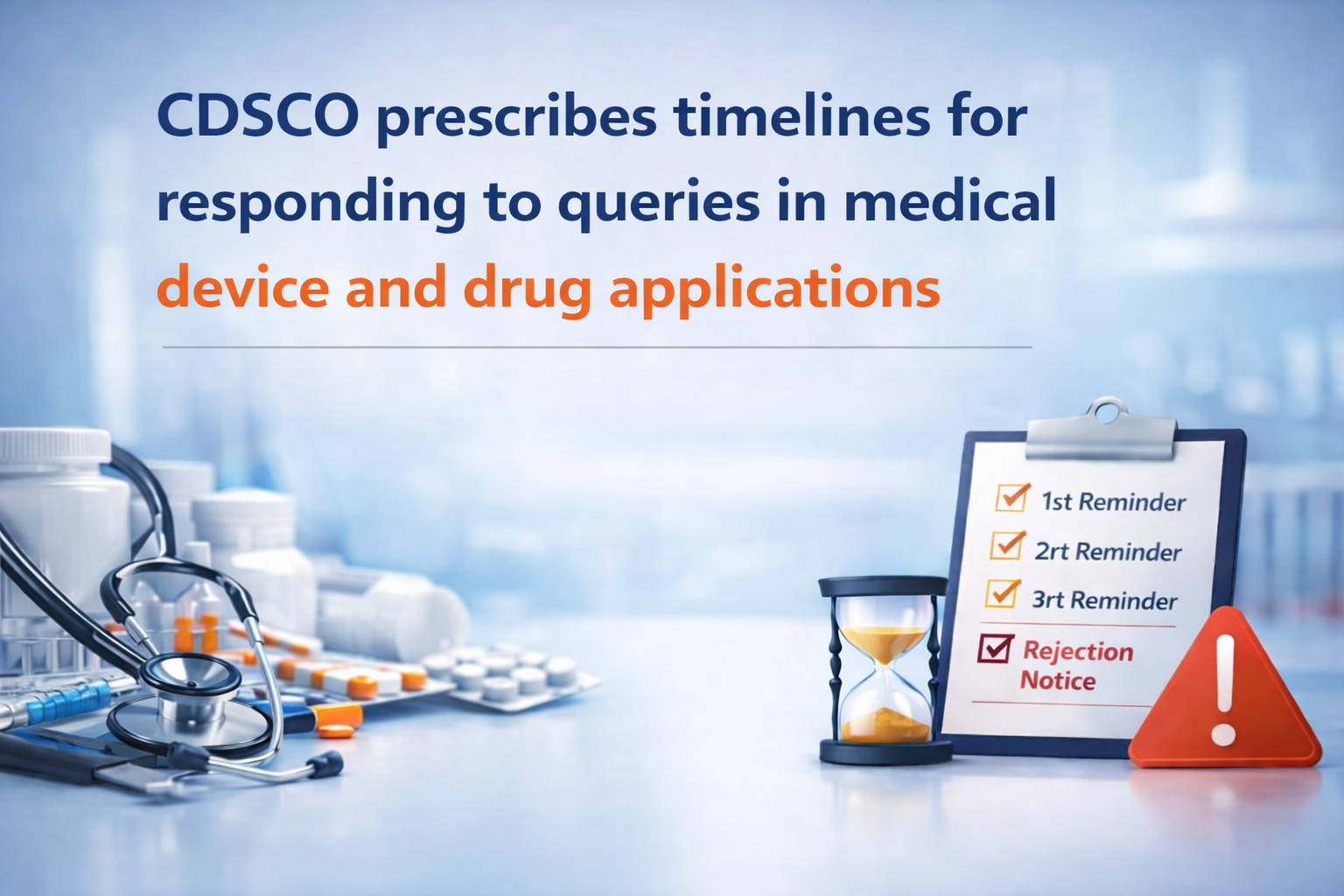
Under the structured reminder mechanism, CDSCO has decided that it will issue reminders at fixed intervals to applicants who do not respond to the official queries to an application in the following manner:
- First Reminder- CDSCO will issue the first reminder if it does not receive response to query. The time-period that CDSCO will wait for response to queries before it issues the first reminder has not been specified.
- Second reminder – If no response to queries is received within 30 days of first reminder, a second reminder will be issued o.
- Third reminder – If no response to queries is received within 30 days of second reminder, a third and final reminder will be issued.
- Disposal Notice – If no response to queries is received within 30 days of issuance of third reminder, CDSCO will issue dispose the application.
Will the disposal of application due to non-response to queries be treated as rejection of the application effectively barring the applicant to make the same application again?
The disposal by CDSCO should not be treated as rejection of the application. This means that the applicant should be able to apply for license again for the same products, even if the application for same products has been rejected before for want of response to queries.
Whether the government fees paid be refunded or reused or adjusted in case of disposal of application of CDSCO on grounds of non-response to queries?
As per the public notice, the government fees paid will not be refunded or reused or adjusted once the underlying application is disposed by CDSCO due to non-receipt of response to queries despite three reminders.
What will happen to product applications that are pending for more than two years?
Where an application has remained pending for over two years, but no queries have been raised by CDSCO, there is currently no clarity on how such cases will be treated. Based on the language and intent of the public notice, such applications should not be disposed, because the structured reminder mechanism gets triggered only when queries raised by CDSCO are not responded to by the applicants.
Where queries have been raised in the application, but the applicant is yet to receive three reminders from CDSCO as described in the structured reminder mechanism, it is unclear what will happen because the public notice does not provide any guidance on this issue. In our view, such applications should not get disposed by CDSCO for want of response since the disposal of application under the structured reminder mechanism can happen only after issuance of three reminders by CDSCO. However, CDSCO is free to follow its own processes and cannot be blamed for disposal of application without notice on the ground that the applicant has not responded to queries and appears to have abandoned the application.
Is it possible to seek extension of the timeline?
It is unclear whether CDSCO will entertain extension of timeline beyond the timeline of 90 days prescribed under the structured reminder mechanism. The Public Notice leaves some flexibility for making an application for extension of timeline. However, the final decision on extension of timeline beyond the 90 day window under the structured reminder mechanism will rest with CDSCO.
Is it possible to partly respond to CDSCO’s queries and respond to remainder of the queries later?
It is unclear whether CDSCO will entertain partial response to queries as sufficient to stop the 90 day clock under its structured reminder mechanism. However, in the event of time-crunch, it may be pragmatic to submit a partial response to queries than to submit no response at all.
What is timeline for CDSCO to issue queries after submission of an application?
CDSCO has not committed to a timeline to review application and issue queries to applicants.
What is the timeline within which an applicant must respond to queries raised on the application to avoid receipt of first reminder from CDSCO?
CDSCO has not indicated any expectation on timeline within which applicants should respond to its queries to avoid receiving the first reminder.
Will State Drug and Medical Device Licensing Authorities also follow structured reminder mechanism and dispose applications due to non-response to queries?
The State Drug and Medical Device Licensing Authorities are not bound to follow the structured reminder mechanism as published by CDSCO in its public notice. For all practical purposes, the structured reminder mechanism should be assumed to be applicable to CDSCO only.
There is a statutory timeline prescribed for processing most product license applications. What happens to the statutory timeline is the impact of query on statutory timeline of processing of an application?
The statutory timelines prescribed for processing drug, medical device or cosmetic license by CDSCO or State Licensing Authority are considered to be suspended upon receipt of queries from the regulatory authority.
Take-away for industry
It may be pragmatic for manufacturers and importers of drugs and medical device manufacturers to respond official queries received to their product applications at the earliest opportunity and in the best possible way, to avoid repeat queries or reminders from CDSCO. It is possible that some queries may require more time to respond than other queries, at which time appropriate regulatory strategy should be formulated to address all queries so as to avoid disposal or rejection of application and consequent loss of valuable time and government fees.