TOP 5 HEALTH LAWS AND POLICY UPDATES

Dear Readers, we are happy to share the most interesting legal and policy updates concerning health industry that we read today. We hope you enjoy reading it.

1. Punjab’s Food and Drugs Administration (FDA) has cancelled a pharmaceutical manufacturer’s licence and ordered a nationwide product recall following findings that allegedly linked substandard oxytocin injections to maternal deaths. The action highlights increased scrutiny of GMP compliance and data integrity, signalling stricter enforcement where product quality deficiencies may endanger patient safety.
Source: shortlink.uk/1rjtj

2. Maharashtra’s FDA has uncovered a supply of falsely labelled “sterile” surgical gloves to government hospitals in Mumbai. The gloves were allegedly unsterilised due to company’s sterilization machine was malfunctioning, prompting raids and seizure of stock. The company responsible had attempted to recall the unsterilized surgical gloves before the raid with no success. Authorities are investigating licensing violations and whether proper recall procedures were followed.
Source: shortlink.uk/1rjtr

3. A U.S. federal court has allowed a proposed class-action lawsuit to proceed against a manufacturer of a children’s nutritional drink over allegations that its marketing and packaging misled consumers into believing the product was clinically proven to help children grow taller. The court held that product claims, combined with visual branding and advertising elements, could reasonably be interpreted by consumers as referring to height growth rather than general growth and development. The lawsuit alleges that consumers were misled regarding the product’s benefits, while the company maintains that its claims are scientifically supported and appropriately describe the product’s role in supporting children’s growth and development. The case will now proceed for further judicial consideration.
Source: shortlink.uk/1rjtH

4. India’s Directorate General of Foreign Trade has exempted Special Economic Zone (SEZ) units and developers from the applicability of conditions of Quality Control Orders (QCO) and Bureau of Indian Standards (BIS) rules. This exemption will be applicable on the permissible good imported like raw materials and capital goods which are authorized for SEZ operations. However, if these imported items or their resulting manufactured products are moved into the Domestic Tariff Area (DTA), they will be required to fully comply with all applicable QCO and BIS laws. Additionally, SEZ entities will have to submit a formal undertaking to the Development Commissioner at the time of import.
Source: shortlink.uk/1rjtg

5. The United States Food and Drug Administration is conducting a scientific safety review of mifepristone, the abortion pill, using existing drug safety systems. The review could influence future distribution requirements for the medicine. While the agency maintains that mifepristone is safe and effective when used as directed, abortion rights groups have criticized the review.
Source: shortlink.uk/1rjtT

TOP 5 HEALTH LAWS AND POLICY UPDATES

Dear Readers, we are happy to share the most interesting legal and policy updates concerning health industry that we read today. We hope you enjoy reading it.

1. The National Health Authority is developing a national artificial intelligence policy for healthcare to guide wider use of technology to address health challenges including diagnostics, public health programmes, and digital health platforms. This will be a major shift toward structured, large-scale adoption of technology in India’s health system. It can improve access, efficiency, and data-driven decision-making across public healthcare delivery.
Source: shortlink.uk/1tzfD

2. India’s Central government has directed states to uniformise package rates for common medical procedures, adopt uniform treatment guidelines, and implement digital claims processing through the National Health Claims Exchange to improve billing transparency and reduce pricing variations across private hospitals. These disparities have been identified in driving higher insurance premiums and affecting affordability.
Source: shortlink.uk/1ohsz

3. The Bombay High Court delivered a judgment after scrutinising enforcement under the Drugs (Prices Control) Order (DPCO), holding that overcharging determinations and recovery demands must strictly adhere to statutory methodology, including correct price fixation, computation, and grant of hearing. Finding procedural infirmities and inadequate reasoning, the Court set aside the demand and directed fresh adjudication, reinforcing due process and curbing arbitrary.
Source: shortlink.uk/1tzfM

4. The Central Drugs Standard Control Organization (CDSCO) has issued a regulatory communication outlining updated requirements related to drug approvals, compliance, and regulatory submissions for industry stakeholders. This is important as increased regulatory scrutiny may impact approval timelines and documentation standards. Companies may now need to review regulatory submissions, strengthen compliance processes, and align product lifecycle strategies with evolving CDSCO expectations.
Source: shortlink.uk/1tzfQ

5. The Drugs Technical Advisory Board has approved a proposal to amend the Medical Devices Rules, 2017 to introduce a definition of reportable events and mandate adverse event reporting, including for in-vitro diagnostic devices. This is important as it strengthens post-market surveillance and device safety oversight. Manufacturers and importers may now need enhanced reporting systems and tighter compliance processes.
Source: shortlink.uk/1ohsK

TOP 5 HEALTH LAWS AND POLICY UPDATES

Dear Readers, we are happy to share the most interesting legal and policy updates concerning health industry that we read today. We hope you enjoy reading it.

1. India’s central drug regulator, CDSCO has requested state drug regulators to direct manufacturers of Carbimazole formulations to incorporate agranulocytosis as an adverse drug reaction in Prescribing Information Leaflets (PIL) following recommendation by the Subject Expert Committee on Endocrinology and Metabolism.
Source: short-url.org/1pcz1

2. The Central Pollution Control Board (CPCB) has introduced a Common EPR Portal to unify all Extended Producer Responsibility activities under one platform. Through Single Sign-On (SSO), users can access Plastic, E-Waste, Battery, Tyre and Used Oil Management portals, and the EPR Trading Platform with one login. Registration is mandatory, with no additional fee.
Source: short-url.org/1pcz4

3. The Madras High Court has reportedly strongly criticised the practice of imposing non-compete and non-solicitation clauses on doctors in employment contracts, calling such restrictive covenants “unlawful on the face of it” and questioning their enforceability in healthcare settings. The bench indicated it will discourage hospitals from using these clauses, emphasising doctors’ freedom to practice and patient choice.
Source: short-url.org/1pcz6

4. The National Pharmaceutical Pricing Authority has reportedly deferred a decision on creating a separate price ceiling for cementless knee implants. The Multidisciplinary Committee will invite subject experts and manufacturers for detailed deliberations. Until a final determination is made, all companies must continue complying with the existing ceiling prices.
Source: short-url.org/1k7in

5. India’s drug regulator CDSCO is enhancing the online WHO-GMP Certificate of Pharmaceutical Product (CoPP) application via its ONDLS portal, partnering with C-DAC and state authorities to replace manual submissions. The digital shift aims to cut delays, improve transparency, and boost export readiness for Indian pharma manufacturers.
Source: short-url.org/1pcze

TOP 5 HEALTH LAWS AND POLICY UPDATES

Dear Readers, we are happy to share the most interesting legal and policy updates concerning health industry that we read today. We hope you enjoy reading it.

1. India has reportedly agreed to reduce tariffs on a broad range of U.S. exports, including medical devices, manufactured goods and chemicals from about 13.5% to zero. Lower tariffs on medical devices from the US would help hospitals and clinics in India to procure advanced equipment more cheaply, improving healthcare delivery and access.
Source: h7.cl/1ow26

2. US FDA has shut down over 200 illegal online pharmacy websites linked to an India-based criminal network. The sites allegedly sold unapproved and counterfeit medicines to U.S. consumers, raising serious public health concerns and highlighting the need for stronger regulation and cross-border cooperation.
Source: h7.cl/1ow29

3. The Indian government is reportedly examining a proposal to mandate pharmaceutical companies to allocate at least 1% of their net profits for free medicines during health emergencies by amending the Drugs Rules, 1945. However, the move faces legal constraints, as CSR spending is governed by the Companies Act, 2013. The central drugs regulator, CDSCO, is reassessing the proposal’s feasibility.
Source: h7.cl/1ow2c

4. The Association of Indian Medical Device Industry (AiMEd) has reportedly opposed any reconsideration or easing of policy restrictions on importing refurbished or pre-owned medical equipment. Association has urged the government to uphold the ban on imports, enforce stricter regulations by emphasizing the strengthening of indigenous innovation like Make in India.
Source: h7.cl/1ow2i

5. A leading fast moving consumer goods manufacturer has filed a suit in the Calcutta High Court, alleging deceptive imitation of its biscuit packaging and trade dress by a rival. The suit seeks injunction against sale and distribution, claiming consumer confusion and unfair competition. The court has taken the matter on record and scheduled further hearing shortly.
Source: h7.cl/1jt71

TOP 5 HEALTH LAWS AND POLICY UPDATES

Dear Readers, we are happy to share the most interesting legal and policy updates concerning health industry that we read today. We hope you enjoy reading it.

1. The Ministry of Health has issued draft amendments to the New Drugs and Clinical Trials Rules, 2019, proposing to remove the provision dealing with the provisional registration of Ethics Committees. The designated authority will now directly grant final registration in Form CT-03 after scrutiny of Form CT-01, or reject with written reasons.
Source: h7.cl/1oifC

2. Bulk Drug Manufacturers Association of India has launched a marketing portal enabling Indian pharmaceutical companies to promote and source active pharmaceutical ingredients, intermediates, pallets, and contract development and manufacturing services, supporting both domestic and international markets through an integrated vendor management system with no cost registration for buyers.
Source: h7.cl/1oifJ

3. The Department of Pharmaceuticals has extended the deadline for submitting applications under the Common Facilities for Medical Device Clusters (CFMDC) sub-scheme to 15 February 2026. The scheme supports shared testing infrastructure for medical devices, including cardiac and orthopaedic implants, infusion pumps, imaging equipment, and Class B, C, and D IVDs.
Source: h7.cl/1jfLz

4. The Maharashtra government has issued a resolution by introducing a new fee structure at state-run hospitals from effective from January 16, 2026. ₹5 for OPD registration, ₹10/day for inpatient admission, and up to ₹40,000 for major surgeries like joint replacements. Diagnostic services, ICU care, and ambulance services also have updated charges. Implementation across hospitals is pending.
Source: h7.cl/1oiwW

5. The Indian Pharmacopoeia Commission is reportedly taking efforts to develop more biosimilar in alignment with governments Biopharma Shakti initiative. This move aims to align Indian quality standards with global benchmarks and strengthen the country’s biologics and biosimilars ecosystem.
Source: h7.cl/1jfLU

TOP 5 HEALTH LAWS AND POLICY UPDATES

Dear Readers, we are happy to share the most interesting legal and policy updates concerning health industry that we read today. We hope you enjoy reading it.

1. The Ministry of Health and Family Welfare has constituted a committee to develop a policy governing refurbished medical devices. The committee will examine the scope of refurbished medical devices, methodology to evaluate the safety, performance, and remaining useful life of refurbished medical devices & suggest guidance for waste disposal of such refurbished devices.
Source: h7.cl/1o8qd

2. Indian government has announced a tax holiday until 2047 for foreign companies that provide cloud services globally using data centres located in India. Further, there will be no risk of foreign firms’ global income being taxed in India solely because they use Indian data centres. This move is aimed at attracting long-term investment into India’s digital infrastructure.
Source: h7.cl/1o8qp

3. Indian Government has released first national evidence-based lung cancer treatment and palliation guidelines. It offers 15 recommendations to standardise diagnosis, treatment and palliative care, improve early detection, reduce treatment disparities and ensure consistent, patient-centred care across the country.
Source: h7.cl/1o8qA

4. India’s Ministry of Consumer Affairs issued show-cause notices to major edible oil companies for violating the amended Vegetable Oils Products, Production and Availability (VOPPA) Order, 2025. Companies failed to submit monthly production data and register on official portals. Authorities have warned that continued non-compliance could lead to inspections and confiscation under the Essential Commodities Act, 1955.
Source: h7.cl/1o8qN

5. The United States Food and Drug Administration has launched the PreCheck pilot program to strengthen domestic pharmaceutical manufacturing. The initiative offers early regulatory engagement for new manufacturing facilities, improving predictability, streamlining facility assessments and accelerating readiness to supply medicines for the United States market.
Source: h7.cl/1o8qS

TOP 5 HEALTH LAWS AND POLICY UPDATES

Dear Readers, we are happy to share the most interesting legal and policy updates concerning health industry that we read today. We hope you enjoy reading it.

1. The Karnataka Health Department has proposed introducing QR codes on medicine strips and boxes to help visually impaired patients access key drug information via smartphone scanning under the IMPACT-VIP programme. Details such as dosage, composition, and expiry dates can be accessed, and the proposal may be sent to the Centre for wider implementation.
Source: h7.cl/1o2Wy

2. India’s central drugs regulatory authority (CDSCO) has released a draft guidance outlining regulatory requirements and online procedures for importing in-vitro diagnostic medical devices. The document aims to streamline approvals under Medical Devices Rules, 2017. Comments from stakeholders are invited within 15 days.
Source: h7.cl/1j0Wg

3. The Government of India has in the Union Budget 2026–27 announced measures to position India as a hub for medical tourism, biopharmaceutical manufacturing and traditional medicine. The government will establish five regional medical hubs, expand Ayurveda, Yoga, Unani, Siddha and Homeopathy infrastructure, and strengthen research, manufacturing capacity and employment across the healthcare value chain.
Source: h7.cl/1o2WE

4. The Government of India is planning to amend the Drugs and Cosmetics Act to tighten oversight of pharmaceutical opioids, proposing stricter penalties, higher fines, and enhanced monitoring of manufacturing and sales to curb misuse, diversion, and illegal distribution while strengthening regulatory enforcement.
Source: h7.cl/1j0Wr

5. Indian Pharmacopoeia Commission has issued a formal circular urging all Medical Device Marketing Authorisation Holders (MAHs) to strictly comply with adverse event reporting requirements under the Materiovigilance Programme of India (MvPI). The move is aimed at bolstering patient safety and enhancing the post-market surveillance ecosystem for medical devices across India.
Source: h7.cl/1o2WQ

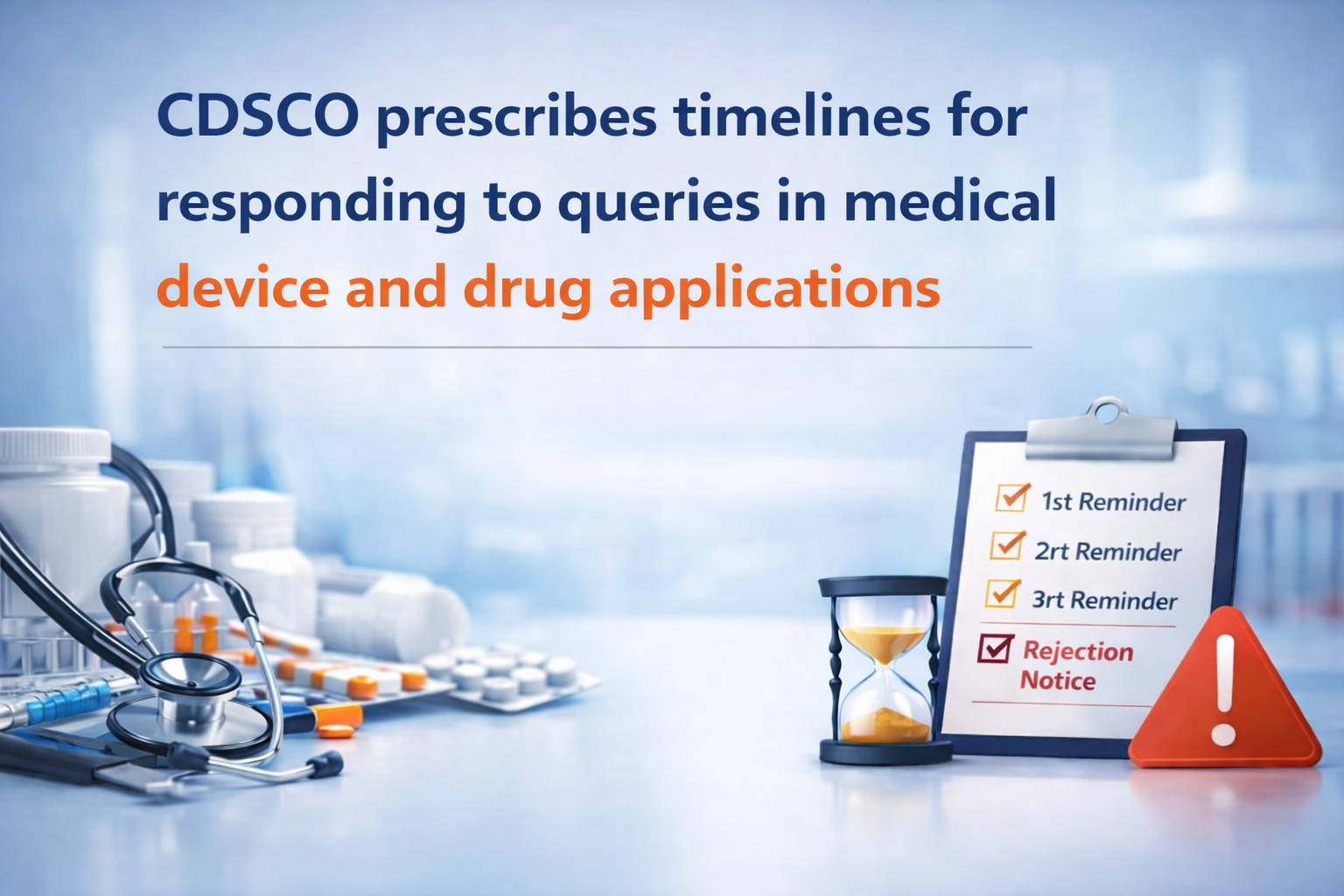
The 90 Day Rule: Indian Drug and Medical Device Regulator (CDSCO) tightens query response timelines on applications 

India’s Central Drug and Medical Device Regulator, The Central Drugs Standard Control Organisation (CDSCO), has made it clear that it will reject product applications if the official queries to the applications are not responded within 90 days from the date of receipt of the first official reminder.

Background
On January 16, 2026, CDSCO issued a public notice informing the general public that it has initiated a time-bound reminder and rejection mechanism to ensure timely disposal of the pending applications. As per CDSCO, a large number of product applications across categories such as new drugs, cosmetics, biologics, medical devices and IVDs are pending since 8 to 10 years because of non- submission of responses to queries on product application raised on the official electronic submission portal (SUGAM portal).

In the notice, CDSCO issued a final warning to applicants whose application has been pending for more than two years for want of response to queries and who have received three reminders from CDSCO requesting submission of response to query. If such applicants fail to respond to queries within 30 days from date of public notice i.e. by 14 February 2026, it will result in rejection of the application.

The CDSCO also used the opportunity to inform the public that it has instituted a structured reminder mechanism for queries to applications under which it was going to issue three reminders to applicants in relation to unresponded queries. This structured reminder system and consequences of failing to respond to queries are discussed in the paragraphs below.

CDSCO’s Structured reminder mechanism
Under the structured reminder mechanism, CDSCO has decided that it will issue reminders at fixed intervals to applicants who do not respond to the official queries to an application in the following manner:

  • First Reminder- CDSCO will issue the first reminder if it does not receive response to query. The time-period that CDSCO will wait for response to queries before it issues the first reminder has not been specified.
  • Second reminder – If no response to queries is received within 30 days of first reminder, a second reminder will be issued o.
  • Third reminder – If no response to queries is received within 30 days of second reminder, a third and final reminder will be issued.
  • Disposal Notice – If no response to queries is received within 30 days of issuance of third reminder, CDSCO will issue dispose the application.

Will the disposal of application due to non-response to queries be treated as rejection of the application effectively barring the applicant to make the same application again?
The disposal by CDSCO should not be treated as rejection of the application. This means that the applicant should be able to apply for license again for the same products, even if the application for same products has been rejected before for want of response to queries.

Whether the government fees paid be refunded or reused or adjusted in case of disposal of application of CDSCO on grounds of non-response to queries?
As per the public notice, the government fees paid will not be refunded or reused or adjusted once the underlying application is disposed by CDSCO due to non-receipt of response to queries despite three reminders.

What will happen to product applications that are pending for more than two years?
Where an application has remained pending for over two years, but no queries have been raised by CDSCO, there is currently no clarity on how such cases will be treated. Based on the language and intent of the public notice, such applications should not be disposed, because the structured reminder mechanism gets triggered only when queries raised by CDSCO are not responded to by the applicants.
Where queries have been raised in the application, but the applicant is yet to receive three reminders from CDSCO as described in the structured reminder mechanism, it is unclear what will happen because the public notice does not provide any guidance on this issue. In our view, such applications should not get disposed by CDSCO for want of response since the disposal of application under the structured reminder mechanism can happen only after issuance of three reminders by CDSCO. However, CDSCO is free to follow its own processes and cannot be blamed for disposal of application without notice on the ground that the applicant has not responded to queries and appears to have abandoned the application.

Is it possible to seek extension of the timeline?
It is unclear whether CDSCO will entertain extension of timeline beyond the timeline of 90 days prescribed under the structured reminder mechanism. The Public Notice leaves some flexibility for making an application for extension of timeline. However, the final decision on extension of timeline beyond the 90 day window under the structured reminder mechanism will rest with CDSCO.

Is it possible to partly respond to CDSCO’s queries and respond to remainder of the queries later?
It is unclear whether CDSCO will entertain partial response to queries as sufficient to stop the 90 day clock under its structured reminder mechanism. However, in the event of time-crunch, it may be pragmatic to submit a partial response to queries than to submit no response at all.

What is timeline for CDSCO to issue queries after submission of an application?
CDSCO has not committed to a timeline to review application and issue queries to applicants.

What is the timeline within which an applicant must respond to queries raised on the application to avoid receipt of first reminder from CDSCO?
CDSCO has not indicated any expectation on timeline within which applicants should respond to its queries to avoid receiving the first reminder.

Will State Drug and Medical Device Licensing Authorities also follow structured reminder mechanism and dispose applications due to non-response to queries?
The State Drug and Medical Device Licensing Authorities are not bound to follow the structured reminder mechanism as published by CDSCO in its public notice. For all practical purposes, the structured reminder mechanism should be assumed to be applicable to CDSCO only.

There is a statutory timeline prescribed for processing most product license applications. What happens to the statutory timeline is the impact of query on statutory timeline of processing of an application?
The statutory timelines prescribed for processing drug, medical device or cosmetic license by CDSCO or State Licensing Authority are considered to be suspended upon receipt of queries from the regulatory authority.

Take-away for industry
It may be pragmatic for manufacturers and importers of drugs and medical device manufacturers to respond official queries received to their product applications at the earliest opportunity and in the best possible way, to avoid repeat queries or reminders from CDSCO. It is possible that some queries may require more time to respond than other queries, at which time appropriate regulatory strategy should be formulated to address all queries so as to avoid disposal or rejection of application and consequent loss of valuable time and government fees.

TOP 5 HEALTH LAWS AND POLICY UPDATES

Dear Readers, we are happy to share the most interesting legal and policy updates concerning health industry that we read today. We hope you enjoy reading it.

1. The Food Safety and Standards Authority of India has issued draft amendments to the Food Business Licensing Regulations mandating food manufacturers to keep daily production and raw-material records and to follow FIFO/FEFO storage norms. Retailers and non-manufacturers are exempt. The move strengthens traceability, inventory control, and food safety compliance. Public comments are invited within 30 days of Gazette publication.
Source: h7.cl/1iFOX

2. Madras High Court has ruled that the word “Vapo” is a descriptive and generic term derived from “vapour” and cannot be claimed exclusively by any party, rejecting petitions seeking cancellation of trademarks for “Vaporin” products. The Court held that the rival marks and trade dress are distinct and unlikely to cause consumer confusion.
Source: h7.cl/1nG6S

3. India’s Central Government has amended Uniform Consent Guidelines under the Air and Water Acts to simplify industrial approvals and cut delays. Key changes include consolidated consents covering multiple environmental laws, faster timelines for red-category industries, and Consent to Operate remaining valid until cancelled. Inspections, audits, and cancellation powers remain to ensure environmental compliance.
Source: h7.cl/1iFAP

4. The India–EU free trade agreement is set to eliminate duties on about 90% of European medical devices imported into India, reducing tariffs that earlier went up to 27%. The agreement is expected to lower costs and improve access to advanced technologies, Indian manufacturers are seeking regulatory alignment and mutual recognition to overcome non-tariff barriers.
Source: h7.cl/1iFAU

5. The India–EU Free Trade Agreement is expected to expand opportunities for Indian traditional medicine in Europe. In EU countries where no specific regulations exist, AYUSH practitioners will be allowed to offer services based on their Indian qualifications. The agreement also provides long-term certainty for setting up AYUSH wellness centres and clinics across EU member states.
Source: h7.cl/1iFAX

TOP 5 HEALTH LAWS AND POLICY UPDATES

Dear Readers, we are happy to share the most interesting legal and policy updates concerning health industry that we read today. We hope you enjoy reading it.

1. India’s Central Drug and Medical Device Regulator, The Central Drugs Standard Control Organisation (CDSCO), has issued a public notice that it will reject applications if the queries to the applications are not responded within 90 days from the date of receipt of the query on its official application portal called SUGAM portal. A time-bound reminder and rejection mechanism for timely disposal of the pending applications has been introduced. Applications pending for two years will now be rejected after 30 days notice if no response is submitted.
Source: h7.cl/1i6LX

2. India’s Ministry of Commerce and Industry has extended the deadline for importers and manufacturers to obtain BIS certification for aluminium utensils and food and beverage cans covered under the Quality Control Order, 2026. The revised timelines are issued in a phase wise manner based on industry category, beginning from 1 October 2026.
Source: h7.cl/1i6L0

3. Several drug companies are cautious about a new fast approval program under the United States Food and Drug Administration. They fear quicker reviews may weaken scientific scrutiny, increase legal risk, and invite court challenges, even as others support faster access to important medicines for patients nationwide safely.
Source: h7.cl/1i6Lg

4. The Maharashtra Public Health Department has launched dedicated menopause clinics in Pune to provide specialised care for women’s physical and mental health needs. Weekly OPDs will be held every Wednesday at government hospitals, offering medical management, counselling, and lifestyle guidance. The initiative aims to address menopause-related health issues across urban and rural areas.
Source: h7.cl/1n5Uw

5. India’s Ministry of Agriculture and Farmers Welfare has announced that the Seed Act, 2026, to introduces a nationwide seed traceability through QR codes, mandate seed company registration, and impose penalties up to ₹30 lakh for substandard seeds, and safeguards the traditional seed systems and strengths transparency.
Source: h7.cl/1i6Lp