TOP 5 HEALTH LAWS AND POLICY UPDATES

Dear Readers, we are happy to share the most interesting legal and policy updates concerning health industry that we read today. we hope you enjoy reading it.

1. India’s Food authority (FSSAI) has extended the validity of No Objection Certificates (NOCs) granted to imported alcoholic beverages bottled at origin or in bulk with over 10% alcohol content and with no expiry date to 365 days. If consignments remain in Customs premises beyond this period, re-validation can be done through visual inspection upon payment of a prescribed fee.
Source: bit.ly/44Lgsvu

2. India’s Drugs Consultative Committee (DCC) has reportedly proposed enabling the licensing of Bedaquiline, Delamanid, Pretomanid, and Rifapentine only through India’s National Tuberculosis Elimination Programme (NTEP), with strict label warnings. This move aims to prevent misuse, preserve drug effectiveness, and combat rising cases of drug resistant tuberculosis.
Source: bit.ly/4km2dC7

3. The National for Allied and Healthcare Professions (NCAHP) has recommended replacing the term “Paramedical” with “Allied and Healthcare” across all government and institutional communications (verbal, written or electronic). States, UTs, and relevant bodies must implement and enforce this updated terminology in all official usage.
Source: bit.ly/4ltTcYA

4. A popular U.S. snack brand will remove “100% natural” claims from its packaging after lawsuits highlighted trace herbicide residues in its ingredients. Although levels were within legal limits, consumer groups argued the label was misleading.
Source: bit.ly/3TlDeE4

5. The U.S. Food and Drug Administration (FDA) has issued warning letters to four entities, including an Indian drug manufacturer, citing violations such as non-compliance to clinical trial protocol, insanitary conditions, contamination risks, and inadequate donor screening. The FDA has directed them to implement corrective actions to ensure compliance and safeguard product quality.
Source: bit.ly/44aoWw8
Source: bit.ly/45S8eD4
Source: bit.ly/4nqNn01
Source: bit.ly/45Sv11E
TOP 5 HEALTH LAWS AND POLICY UPDATES

Dear Readers, we are happy to share the most interesting legal and policy updates concerning health industry that we read today. we hope you enjoy reading it.

1. Medical device companies have raised concerns over Uniform Code for Marketing Practices for Medical Devices (UCMPMD) and have approached the Department of Pharmaceuticals, citing overreach and operational challenges, particularly in the context of a DGHS advisory that restricted medical representative’s interactions with HCPs in government hospitals.
Source: bit.ly/3InfXiu

2. India’s Central Drugs Standard Control Organisation (CDSCO) is working on making drugs/medicine packaging more readable. The move aims to improve visibility of key details like expiry dates and dosages, addressing concerns over hard-to-read glossy labels. Proposed measures include clearer print standards and digital aids such as voice-enabled QR codes and Braille cards to enhance accessibility and consumer safety.
Source: bit.ly/46oMIpA

3. India’s Drugs Consultative Committee (DCC) has agreed to amend the Drugs Rules, 1945, to include Good Distribution Practices (GDP) guidelines for pharmaceutical products as a separate schedule. The decision follows detailed deliberations and stakeholder consultations to align with revised WHO guidelines.
Source: bit.ly/4lxABuC

4. The U.S. FDA is reportedly planning to revise the labeling for all extended-release stimulants prescribed for attention-deficit hyperactivity disorder (ADHD), requiring inclusion of a “limitation of use” section with a statement on higher rates of adverse reactions in children younger than six years.
Source: bit.ly/4l2REoA

5. The European Commission has amended its regulation to allow electronic instructions for use (eIFUs) for all medical devices intended for professional use, not just high-risk ones. Paper instructions are still required if the device could also be used by patients. eIFUs must be linked in Eudamed (the European medical device database).
Source: bit.ly/4lcdMx1

Labelling requirements under Plastic Waste Management Rules, 2016

As per Plastic Waste Management Rules, 2016, until 1st July 2025, the mandatory declarations on the label of the plastic packaging material should be mentioned on each category of plastic packaging material or plastic packaging of the product. However, starting from 1st July 2025, the declarations can be made in one of the following ways. Please note that this requirement is not in addition to the existing requirements rather a relaxation to declare the mandatory declarations on the plastic packaging material.

Link to the amendment copy: bit.ly/41hEGun

  •  In a barcode or Quick Response (QR) code printed on the plastic packaging
  • In the product information brochure
  • Printed on each individual plastic packaging material
  • Printed on the plastic packaging with the unique number issued under any applicable law (awaiting more clarity from CPCB on this point)

Additionally, the manner of declaration must also be communicated to CPCB.

The labelling requirements required to be printed on plastic packaging material are described below:

  • Name of the importer/brand owner
  • EPR registration certificate number.
  • Thickness of flexible plastic packaging (e.g., plastic sachets, pouches, covers, and carry bags).
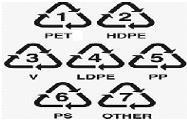
  • For recycled plastic packaging: Please declare “recycled having [—–specify percentage—–] of recycled plastic” along with a mark as shown below and conform to the Indian Standard: IS 14534: 2023 titled as “Plastics — Recovery and Recycling of Plastics Waste — Guidelines”

  • The acronyms PET (Polyethylene terephthalate), HDPE (High-density polyethylene), V (Vinyl/PVC), LDPE (Low-density polyethylene), PP (Polypropylene), PS (Polystyrene), and “Other” mentioned above refers to all other resins and multi-materials like ABS, PPO, PC, PBT, etc.
  • For compostable plastic packaging: Please declare “compostable only under industrial composting” and comply with IS/ISO 17088:2021, titled “Specifications for Compostable Plastics.”
  • For biodegradable plastic packaging: Please declare “Biodegradable in [— specify number of days —] only in the [— specify recipient environment, e.g., soil, landfill, water, etc. —].”

TOP 5 HEALTH LAWS AND POLICY UPDATES

Dear Reader, we are happy to share the most interesting legal and policy updates concerning health industry that we read today. We hope you enjoy reading it.

Absence of essential medicines in a hospital constitutes medical negligence
India’s National Consumer Dispute Redressal Commission (NCDRC) has held that absence of an essential injectable medicine within the hospital, resulting in administration of an alternate injection to a patient who later died, constituted medical negligence. The court ordered the Hospital to pay Rs 25 Lakh as compensation.
Source: bit.ly/3UtaJ7u

Cost of conducting clinical trial of drug published in public domain for first time
Médecins sans frontières (MSF/doctors without borders), a non-governmental organization dedicated to delivering international medical aid, has published cost of conducting clinical trial of a new drug. As per MSF, no pharmaceutical company has published actual cost of conducting clinical trials, though such costs are frequently referenced to justify high drug prices.
Source: bit.ly/3wjvo5J

Indian standards for infant formula permit addition of sugar, therefore controversy surrounding added sugar in infant food unwarranted: Industry
A popular infant formula formulation company has clarified that the sugar content in their product is within the limits prescribed by India’s food regulator, Food Safety and Standards Authority of India (FSSAI). This clarification was issued after reports that the product being sold in low-and-middle income countries has high sugar content.
Source: bit.ly/3UsnaQH

Indian medical device regulator has allowed sale of sleep apnea devices post rectification of foam degradation issue
A major manufacturer of sleep apnea therapy devices has reportedly confirmed that its devices are sold in India without the foam degradation issue, which had previously caused it to recall its devices in India and around the world. In the US, the manufacturer has agreed to provide users of affected devices with new, updated, or equivalent devices with a renewed warranty or a refund.
Source: bit.ly/3WufUXh

Revised guidance for referencing of biological products by biosimilar drugs published for comments by US FDA
The US Food and Drugs Administration (USFDA) has released a revised guidance entitled “Promotional Labeling and Advertising Considerations for Prescription Biological Reference Products, Biosimilar Products, and Interchangeable Biosimilar Products.” The guidance addresses various questions that manufacturers, packers, distributors, and their representatives/firms may have when developing FDA-regulated promotional labeling and advertisements (promotional communications) for prescription reference products, biosimilar products, and interchangeable biosimilar products licensed under the Public Health Service Act (PHS Act).
Source: bit.ly/3wudFsl