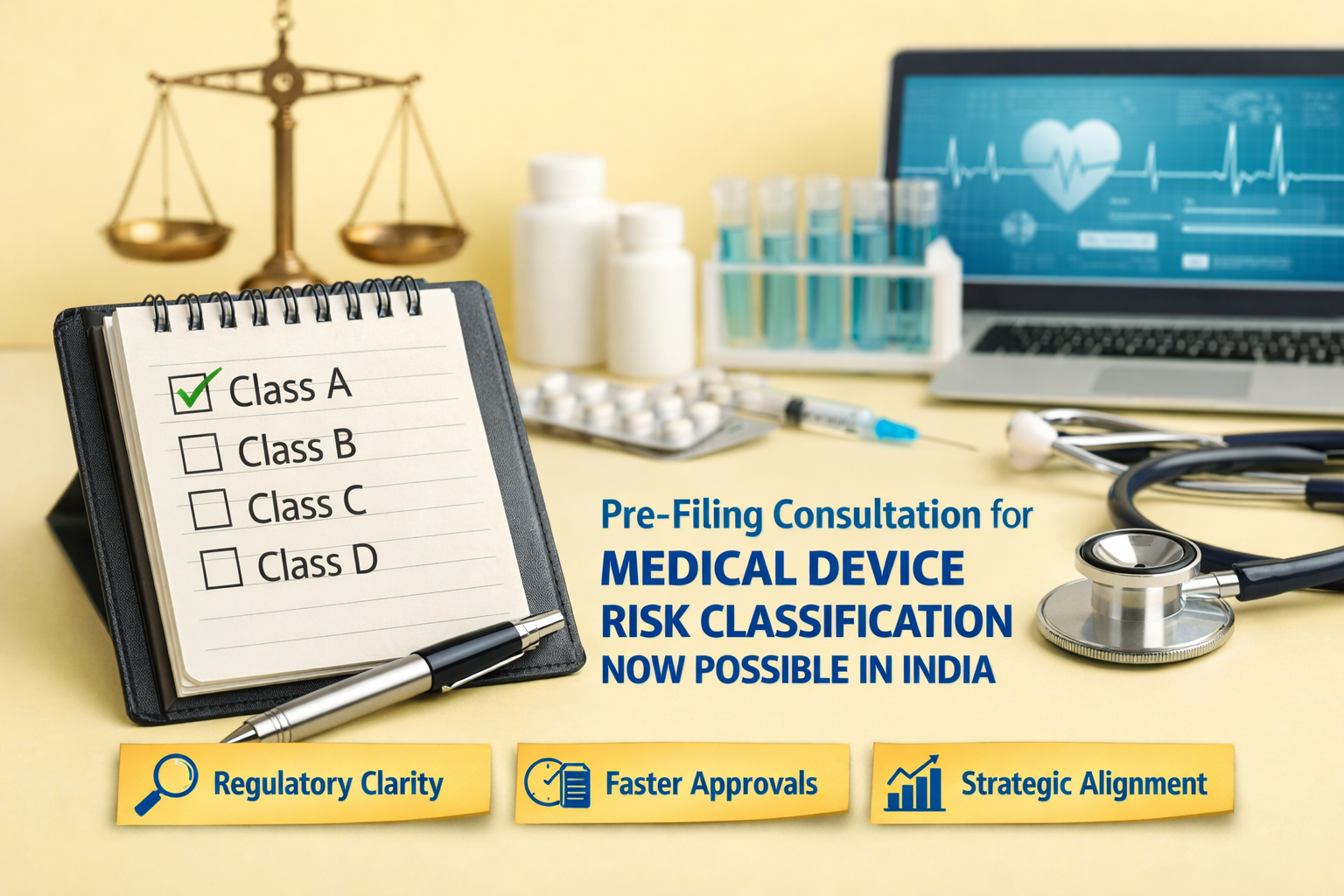
India’s central medical device regulator, The Central Drugs Standard Control Organization (“CDSCO”), has introduced a facility that allows importers and manufacturers of medical devices who are desirous of ascertaining the risk classification of their medical devices to receive an official confirmation on risk classification from the CDSCO.
Regulatory context
India’s medical device regulatory framework differs from most other jurisdictions. In India, risk classification of medical devices is determined by CDSCO and is not self-declared by manufacturers and importers who are making the product license application.
Additional complexity arises from the fact that manufacturing licenses for Class A and Class B devices are issued by State authorities. This has resulted in inconsistent application of risk classification thresholds, with similar products receiving different risk classifications across states. Although CDSCO has issued directions to address this issue, practical challenges continue.
Why does risk classification matter?
The risk classification determines documents and data required, government fees and timelines for obtaining the product license. Therefore, risk classification is a key commercial and strategic factor.
Pre-filing consultation facility
To align risk classification and bring regulatory certainty, CDSCO has introduced a voluntary pre-filing consultation facility to confirm medical device risk classification. The facility is only available to manufacturers and importers of medical devices other than in-vitro diagnostic medical devices (IVDs).
Consultation fee
Please note that there is no consultation fee for availing the facility to determine risk classification of medical devices.
Documents required
In order to avail the facility, the manufacturer or importer is required to submit existing device labels, instructions for use, and the regulatory status of the device in other jurisdictions (like USA, UK, EU, Australia, Canada, or Japan), etc.
Timeline for receiving response on risk classification of medical device from CDSCO
There is no prescribed timeline, and the consultation is best undertaken in parallel with preparation of the main regulatory dossier of medical devices.
Key take-aways for industry
It is pragmatic to undertake pre-consultation when the risk classification of the medical device is unclear.
Early confirmation of risk classification allows companies to plan approval pathways with greater certainty, align licensing strategy at an early stage, and reduce regulatory friction. It also supports better coordination between India-specific regulatory requirements and global product positioning.
Disclaimer: This article is intended for general information purposes only and does not constitute legal advice
Pre-filing consultation for medical device risk classification now possible in India