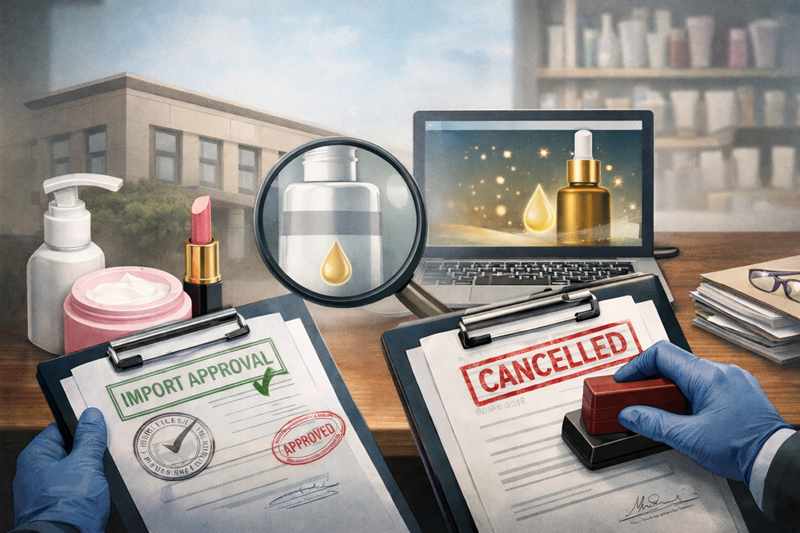
India’s Cosmetic Regulator Cancels Import Registration On Discovering Inconsistencies Between Label Claims and Website Claims

India’s central cosmetics regulator, The Central Drug Standard Control Organization (“CDSCO”), has recently passed an order cancelling the registration of an importer of a cosmetic product after it discovered inconsistency between the claims made on label of the product and claims made on the product website. The order is relevant because it evidences a new trend that the Indian regulator is scrutinizing not just claims made on product label at the time of grant of registration but is also scrutinizing claims made on the product marketing materials and product website after grant of import registration certificate.

In this article, we have summarized the reasons for cancellation of the order and contextualized the cancellation in background of sensitivity of the regulator to cosmetic products that make drug-type claims.

Legal Background

In order to import cosmetics into India, a registration is required to be taken by the importer under The Cosmetics Rules, 2020 (“Cosmetics Rules”). The registration entitles the importer to import cosmetics mentioned in the registration certificate for the term of certificate. However, during the term, the importer has to ensure compliance with conditions of the registration as well as the Cosmetics Rules in order to maintain the registration.

Under Indian law, there is a separate regulatory pathway for import of drugs, and a separate license is required under The Drugs Rules, 1945 (“Drug Rules”) to import drugs in India. The definition of “drug” is very broad, and any substance which makes any claim that it may diagnose, treat, mitigate or prevent any disease or disorder is regulated as a drug.

In other words, a cosmetic product will be regulated as a drug and would require license under Drugs Rules (separate than the registration certificate under Cosmetics Rules), if the importer of cosmetic product makes a claim which qualifies the product to be a drug under Indian laws.

    The CDSCO cancelled the registration certificate of M/s. Esthetic Centers lnternational Pvt. Ltd. for the following reasons:

    a) Inconsistency between the claims made on the label which was submitted to CDSCO at the time of application of registration certificate and the claims made on the website of the product.

    Claims on the approved label Claims on the website
    Anti-hair loss solutionTreatment for Post-Chemotherapy hair loss, Androgenetic alopecia, Seborrhoeic dermatitis of scalp etc.

    b) Nature of the claims being ‘drug’ claim owing to the use of the word “treatment” and reference to human diseases and conditions.

      Key takeaways


    a) It is now evident that CDSCO is scrutinising marketing claims of a cosmetic product including claims made on the product website. The CDSCO appears to be especially sensitive to products which are registered as cosmetics but are found to be making drug claims after receiving registration to import.

    b) CDSCO is taking serious action against registration holders despite the registration holder undertaking to comply with directions and undertaking to remove all inconsistent and drug-type claims from the product website. In this case, the importer had removed all the references to disease conditions from the website, but the CDSCO still cancelled the registration certificate.

    In fact, the CDSCO does not have powers under Cosmetic Rules to cancel registration if the importer of cosmetic product makes a misleading claim in violation of Rule 36 of Cosmetic Rules. Such power is only available against domestic manufacturers of cosmetics due a lacunae in the existing law. However, CDSCO has overlooked the shortcoming and still chosen to cancel the registration, which shows the seriousness with which CDSCO views such violations.

      Conclusion


    It is important for importers, marketers and manufacturers of cosmetics product to ensure that the claims made by them on the label of cosmetics at the time of receipt of registration or license are consistent with the marketing claims made by them after import or manufacture of cosmetic product into India. Any inconsistency, especially with reference to overlap with drug-type claims, can invite serious action including cancellation of import registration are manufacturing license, as the case maybe.
TOP 5 HEALTH LAWS AND POLICY UPDATES

Dear Readers, we are happy to share the most interesting legal and policy updates concerning health industry that we read today. We hope you enjoy reading it.

1. The Health Ministry has prohibited the manufacture, sale and distribution of all immediate-release oral formulations containing Nimesulide above 100 mg, citing potential risks to human safety and availability of safer alternatives. The ban, issued under Section 26A of the Drugs and Cosmetics Act, takes immediate effect across India.
Source: h7.cl/1h4DA

2. The Ministry of Health and Family Welfare has issued draft rules to amend the Drugs Rules, 1945, proposing deletion of “Syrup” from Schedule K, following approval by the Drugs Consultative Committee. Once implemented, syrups would lose regulatory exemptions. Stakeholders are invited to submit objections within 30 days of the notification.
Source: h7.cl/1h4DF

3. India’s drug regulator reportedly cancelled the import licence of a hair loss product after it was promoted as a treatment for post chemotherapy hair loss and other medical conditions. Since the product was approved only as a cosmetic, such therapeutic claims were found misleading and in violation of cosmetic regulations.
Source: h7.cl/1h4DM

4. Leading oral nicotine pouch makers are seeking CDSCO approval to market high dose products as therapeutic nicotine replacement, raising concerns among regulators and health experts about addiction, youth initiation and long-term cardiovascular risks. The move could trigger stricter regulatory scrutiny in India’s pharma and public health landscape.
Source: h7.cl/1h4DN

5. The Telecom Regulatory Authority of India (TRAI) has issued recommendations to regulate the sale of foreign SIM/eSIM cards used in M2M/IoT devices meant for export, proposing a light-touch “International M2M SIM Service Authorisation” with online approval, no entry fees, and 10-year validity to boost exports, support Make in India
Source: h7.cl/1m0FU

TOP 5 HEALTH LAWS AND POLICY UPDATES

Dear Readers, we are happy to share the most interesting legal and policy updates concerning health industry that we read today. We hope you enjoy reading it.

1. The Department of Pharmaceuticals is planning to impose a Minimum Import Price (MIP) on certain active pharmaceutical ingredients and intermediates including potassium clavulanate to deter cheap imports (especially from China) and strengthen domestic raw material production under the PLI scheme.
Source: short-url.org/1fZwh

2. The Delhi High Court has allowed the company to use of the phrase “why settle for ordinary Chyawanprash” in advertisements, but directed removal of the reference “made with 40 herbs”, deeming it disparaging. The court said the remaining claim is permissible as puffery and not misleading.
Source: short-url.org/1fZwo

3. The Bombay High Court has quashed the drug regulator’s stop-production orders against two pharmaceutical companies. The court found the actions violated statutory procedures and denied the companies a fair hearing. However, it clarified that regulators may take fresh action if proper procedures are followed.
Source: short-url.org/1fZwB

4. Telecom Regulatory Authority of India has issued the draft Telecommunication (Broadcasting and Cable) Services Interconnection (Addressable Systems) (Seventh Amendment) Regulations, 2025, seeking stakeholder inputs by 6 October 2025. The draft mandates annual financial year audits, stricter infrastructure sharing rules, and aims for enforcement from 1 April 2026.
Source: short-url.org/1fZwO

5. The Directorate General of Trade Remedies has rescheduled the oral hearing in the anti dumping sunset review of methyl acetoacetate imports from China to October 8, 2025. The review will decide if duties must continue to prevent dumping and protect domestic industry.
Source: short-url.org/1fZwV

TOP 5 HEALTH LAWS AND POLICY UPDATES

Dear Readers, we are happy to share the most interesting legal and policy updates concerning health industry that we read today. we hope you enjoy reading it.

1. India’s Central government has reportedly exempted imported pharmaceutical high-density polyethylene (HDPE) medical-grade plastic from mandatory quality certification under Bureau of Indian Standards regulations to facilitate the production of syringes and IV cannulas and a steady supply of essential products in the healthcare sector.
Source: bit.ly/4ldtUOp

2. The Department of Pharmaceuticals (DoP) has reportedly declined to reveal the names of 30 doctors who accepted ₹1.91 crore worth of foreign trips from major pharmaceutical company. Citing privacy concerns, the DoP resisted disclosing details despite National Medical Commission (NMC) being asked to act. The decision has sparked criticism over transparency and ethical accountability in healthcare.
Source: bit.ly/3G400gp

3. The Karnataka State Pollution Control Board (KSPCB) has clarified that Biomass Briquette/Pellet manufacturing plants do not fall under the scope of the EIA Notification, 2006, which governs environmental impact assessments for specified projects.
Source: bit.ly/4n20u7l

4. The government of India is reportedly tightening oversight of online pharmacies offering rapid deliveries amid concerns over unverified prescriptions, safety, and compliance. A regulatory review is underway to enhance consumer protection and control the proliferation of unregulated digital pharma services.
Source: bit.ly/3G1nDpZ

5. India’s Uttarakhand High Court has quashed a case against a leading Ayurvedic drug manufacturer and its founders over alleged misleading medical advertisements claiming to cure conditions such as diabetes and high cholesterol. The Court cited lack of specific evidence or expert reports to support the allegation that the claims were misleading.
Source: bit.ly/3HZK8vW

TOP 5 HEALTH LAWS AND POLICY UPDATES

Dear Readers, we are happy to share the most interesting legal and policy updates concerning health industry that we read today. we hope you enjoy reading it.

1. Indian Ministry of Environment, Forest, and Climate Change (MoEF&CC) has introduced the Environment (Construction and Demolition) Waste Management Rules, 2025, effective from April 1, 2026. These Rules apply to construction, demolition, remodeling, renovation, and repair activities, with key provisions on Extended Producer Responsibility (EPR) and waste management plans.
Source: bit.ly/42AOQIu

2. India’s Central Drugs Standard Control Organization (CDSCO) has issued a Standard Operating Procedures (SOPs) to streamline the transfer of drugs manufactured in Special Economic Zones (SEZs) to domestic markets (Domestic Tariff Area) for sale and distribution. SEZ units are exempted from mandatory import and registration requirements, provided these drugs are not diverted for domestic sale and are used exclusively for export purposes.
Source: bit.ly/44ftUYL

3. Pune Municipal Corporation has issued notices to private hospitals instructing to not demand any advance deposit from patients seeking emergency medical care and to strictly follow the Bombay Nursing Home Registration Act, 1949, which forbids demanding any advance deposit from “emergency” patients.
Source: bit.ly/4j52xp2

4. A content creator agreed to remove part of a podcast after a company objected to a guest’s remarks about an antiseptic product. The guest’s claims were considered disparaging. The court-approved settlement also required related social media posts to be deleted to protect the product’s reputation.
Source: bit.ly/42sBOeV

5. A global agricultural company is helping Indian rice farmers adopt eco-friendly farming methods. These practices reduce harmful greenhouse gases. In return, the company will issue its first carbon credits, certified by Gold Standard, which environmentally conscious companies can purchase to offset their emissions.
Source: bit.ly/4iavSgm

TOP 5 HEALTH LAWS AND POLICY UPDATES

1. The Supreme Court has issued its decision in a matter concerning the legality of exercise of powers by the National Pharmaceutical Pricing Authority (NPPA) in levying overcharging fees against an entity that claimed not to be a “distributor” or a “dealer” as defined under the Drugs (Prices Control) Order, 1995, since it had a dual role. The Court held that there is no mutual exclusivity between a dealer and a distributor, and dismissed the appeal.
Source: bit.ly/3xPkgP1

2. The National Medical Commission, has mandated the presence and maintenance of a Tobacco Cessation Centre at all hospitals attached to Medical Colleges across the country.
Source: bit.ly/3WdIjzk

3. To curb rise in misleading advertisements, the Central Government may soon introduce regulation to restrict the advertisement of Diabetes, Sex Hormone and Oncology medication, and may require approval and permission to make claims of efficacy for these Drugs.
Source: bit.ly/46nCjst

4. The Ministry of Health and Family Welfare has published Draft Drugs (Amendment) Rules, 2024 whereby it intends to amend Rule 96 requiring inclusion of details of Drug excipients on retail labels of Drugs.
Source: bit.ly/463YZO9

5. The European Commission has published and adopted the Artificial Intelligence Act, which will regulate the inclusion and integration of AI into Medical Devices and In-Vitro Devices. This Act is set to come into force on the 2nd August 2024.
Source: bit.ly/3Y5qCUV

TOP 5 HEALTH LAWS AND POLICY UPDATES

Dear Reader, We are happy to share the most interesting legal and policy updates concerning health industry that we read today. We hope you enjoy reading it.

Manufacturers of tobacco products required to register their packing machine(s) with tax authorities
India’s Central Board of Indirect Taxes and Customs (CBIC) has postponed the timeline for manufacturers of tobacco products such as pan-masala, chewing tobacco, smoking mixtures, etc. to report their production capacity. CBIC had in January this year announced that producers must register their filling and packing machines and report these details. The measure was set to be implemented from 1st April 2024. However, the new effective date for implementation of the timeline is now 15th May 2024.
Source: bit.ly/3xz7400

NPPA releases draft ceiling price calculation sheets of seven scheduled formulations
The National Pharmaceutical Pricing Authority (NPPA) has published a preliminary calculation of ceiling prices for seven drug and vaccine formulations, inviting feedback from stakeholders within a ten-day period. These ceiling prices have been adjusted to reflect the minimum and maximum market prices of the products, in accordance with the updated Schedule I of the Drugs (Prices Control) Order, 2013, aligning with the National List of Essential Medicines (NLEM), 2022. The move shall be affecting major pharmaceutical giants in the business of ORS, vaccines and more.
Source: bit.ly/3UhjK4J

High Courts should interfere only when the case in lower court was decided by fraud or collusion: Supreme Court of India
While deciding an appeal against the order of the High Court, the Supreme Court of India observed that the High Court should apply care and caution while entertaining the petitions under Article 226 of the Constitution. The Court further explained that, in case of an already available alternative statutory remedy, the High Court should interfere in the matter only when the case is decided by fraud or collusion, otherwise an order in the same matter by the High Court will mean reopening the issues that have achieved finality.
Source: bit.ly/4cNGwIJ

Goa FDA to get the status of “US FDA observer” amid surge in increase in retail and wholesale licenses
The Goa Food and Drug Administration (FDA) has been extended the invitation to participate as “FDA observer” for inspections conducted by the USFDA India Office. This development came as a result of increase in retail and wholesale licenses issued by Goa FDA and their familiarity with the US FDA’s inspection process.
Source: bit.ly/3UfqIHq

Rejecting apology of the Directors of a Company for misleading advertisements, the Supreme Court sets caution for FMCG companies
Observing caution for fast-moving consumer good (FMCG) companies, the Supreme Court of India has refused to accept an apology from a major Indian Ayurvedic medicine manufacturer for misleading advertisements regarding its products in contravention of an undertaking provided to the Court. The Supreme Court stated that misleading advertisements by FMCG companies result in deceiving innocent consumers and play with public health.
Source: bit.ly/3PYqoKq

TOP 5 HEALTH LAWS AND POLICY UPDATES

Dear Reader, We are happy to share the most interesting legal and policy updates concerning health industry that we read today. We hope you enjoy reading it.

Periodic Safety Update Reports for Medical Devices to be filed only through online portal of CDSCO
The Central Medical Devices Regulator of India (Central Drugs Standards Control Organization) has issued a circular, stating that starting on 1st April 2024 it will require and restrict all manufacturers of Medical Devices/ In-vitro Devices to make submission of Periodic Safety Update Reports, only on the online portal and that offline mode of submission of application will not be accepted going forward.
Source: bit.ly/3TEO74B

Absence of Regulation of Second-Hand Medical Devices being Imported into India flagged by Parliamentary Panel
The Department-related Parliamentary Standing Committee on Chemicals and Fertilisers, in a recent report, has highlighted that currently India’s Central Medical Device Regulations (Medical Devices Rules, 2017) do not regulate second-hand medical devices. The Committee has recommended framing policy to ensure its quality and safety, as well as introducing possible restrictions on import of second-hand or refurbished Medical Devices into India.
Source: bit.ly/3VsdCaQ

Supreme Court Orders Director of Company as well as Endorser of offending Advertisement to be present for Contempt Proceedings relating to misleading advertisements
As part of the ongoing action being taken against a major Indian Ayurvedic Medicine manufacturer for publication of misleading advertisements regarding its products in contravention of an undertaking provided to the Court, the Supreme Court, in pursuance of determining whether to pursue contempt proceedings against the manufacturer, has issued an order requiring the physical presence of the Director of the entity as well as a prominent Ayurvedic Yoga practitioner who had given his endorsement to the claims made in the offending advertisements of the Company.
Source: bit.ly/3vu45VQ

Delhi High Court orders suspension of accounts accused of impersonation of prominent investment group despite objection that no evidence of involvement is provided.
In pursuance of ongoing action against certain anonymous persons impersonating a prominent Investment group and misleading the general public, the Delhi High Court has issued a further order to messaging platform WhatsApp to take action to remove/ block access to certain accounts/ messaging groups, despite objection from the platform that the account/ messaging groups have been prove to neither violate T&Cs of WhatsApp, nor having carried out any illegal activity.
Source: bit.ly/3vkn7hu

EU Parliamentary Committee votes to present amendment to increase exclusivity period for orphan drugs and introduce extended regulatory data-protection period.
The European Parliamentary Committee on Environment, Public Health and Food Safety has voted in favour of introducing several amendments to the current EU Pharmaceutical Directive, including a controversial proposal to increase the exclusivity period for Orphan Drugs from 10 to 11 years, as well as an extended regulatory data-protection period of 9 years; both decisions that industry experts believe may have adverse consequences for competition in the EU Pharmaceutical Market.
Source: bit.ly/3Vr9zeK

TOP 5 HEALTH LAWS & POLICY UPDATES

Dear Reader, We are happy to share the most interesting legal and policy updates concerning health industry that we read today. We hope you enjoy reading it.

Human Rights body to probe sale of drugs with identical brand names in India
The National Human Rights Commission (NHRC) in India has taken suo motu cognizance of a newspaper report which stated that many drugs in India were being sold with identical brand names for treating different medical conditions. NHRC has issued notice to Secretary, Ministry of Health and Family Welfare and Central Drugs Regulator, asking for detailed report within four (04) weeks.
Source: bit.ly/3SB8WfB

India’s Environment Regulator to take action against unregistered recyclers and refurbisher of battery waste
India’s Central Pollution Control Board (CPCB) has issued direction to all State Pollution Control Board (SPCB) and Pollution Control Committees (PCCs) to ensure compliance with Battery Waste Management Rules, 2022 by recyclers and refurbishers of battery waste. CPCB has directed SPCB/PCC to carry out drives identifying informal / illegal battery waste recyclers, and physically verify facilities of existing waste recyclers. All battery waste recyclers and refurbishers are obligated to register under Battery Waste Management Rules, 2022.
Source: bit.ly/3OGJTGI

Difference of manufacturing process will not take away ability of manufacturer of product manufacturer to enforce product patent, if the product is covered by Product-by-Process Patent: High Court
The Delhi High Court of India has held that a product-by-process patent would be enforceable even if the alleged infringement relates to manufacturing of a product using process which is different than the one claimed in patent. The High Court was dealing with a matter relating to manufacture of a compound called Ferric Carboxymaltose (FCM) which was patented by the Innovator. The defendants had raised an argument that they are not covered by the patent because they were following a different process to manufacture FCM. However, the argument was rejected by the High Court.
Source: bit.ly/3OGtr9C

Manufacturers of medical devices who do not wish to disclose name and address of manufacturing facility, may apply for neutral code on central portal
The Indian medical devices regulator, Central Drugs Standard Control Organization (CDSCO) has direct all the manufacturers of medical devices for export purposes to submit the applications for neutral code through online system of medical devices portal only. If a neutral code is declared on the label of package, it does not have to bear the name and address of the manufacturer. The online portal is now functional to accept the applications.
Source: bit.ly/3SWgTxn

Recommendations for COVID legislation received from Law Commission of India
The Law Commission of India has submitted its report titled “A Comprehensive Review of the Epidemic Diseases Act, 1897″ to the Government of India. The commission has recommended either to amend the existing law or enact the new legislation to address the underlying gaps in the Epidemic Diseases Act, 1897. The 1897 was relied on by the Government of India to introduce various controls during the COVID pandemic, including lock downs.
Source: bit.ly/3SWMdMm

Legality of making COVID-19 defence or immunity claims in India

India’s central drug regulator, the Drugs Controller General of India, has reportedly served a notice on a major FMCG company in India to explain why action should not be taken against it for making a misleading claim that its hand sanitizer is a “immunity booster” and that it “kills inactive coronavirus”. This points to an increasing trend amongst FMCG Companies who are making COVID-19 or corona virus related claims to capture the hygiene market. The basis for these claims are various World Health Organization (WHO) and scientific reports that have found that ethyl alcohol or isopropyl alcohol is effective in killing the viruses of corona virus family (including SARS-CoV-2) when used over a certain concentration. However, these tests are done in strict laboratory condition and the viruses are exposed to the active ingredients over a period of time to yield result, which does not typically happen in everyday usage of the product. More importantly, it may not be proper to “logically” extend the findings of external scientific reports to any formulation that carries the same active ingredient as the laboratory drug, for the simple reason that in the event of an inquiry, it will be almost impossible for a company to actually test its product for “immunity” or “killing” properties against corona viruses as these viruses are not available in private labs for testing and are generally considered as health and environmental hazards. Therefore, a very clear assessment of risks versus benefit must be done before making a COVID-19 or corona virus related claim for a formulation. In fact, India’s regulator for alternative systems of medicine (Ministry of AYUSH) has expressly prohibited advertisement for COVID-19 treatment by alternative system of medicines (such as Ayurveda and Homeopathy). And, as such, even for making claims such as “kills upto 99.99% germs”, a company must first check whether its formulation is able to satisfy the claim by testing its formulation in a recognized laboratory as per prescribed international standards